
-
CALL US 0203 883 4777
Making Tax Digital for Income Tax 2026: What to Do Now
A sole trader may have completed the first MTD quarterly update without realising that the next deadline is already approaching. A landlord with a second income stream may also be above the threshold once both sources are combined. Making Tax Digital for Income Tax 2026 is no longer a distant reform: for the first mandatory group, the rules began on 6 April 2026.
This guide explains who is in scope, what has changed, which deadlines matter, and what to do if your records or software are not ready. It is based on current HMRC guidance checked on 28 August 2026. If you want professional support with setup and ongoing reporting, Apex Accountants’ Making Tax Digital accountants can help you prepare and manage the process.
Key Takeaways
- Sole traders and landlords with qualifying income over £50,000 for 2024–25 should have started using MTD from 6 April 2026.
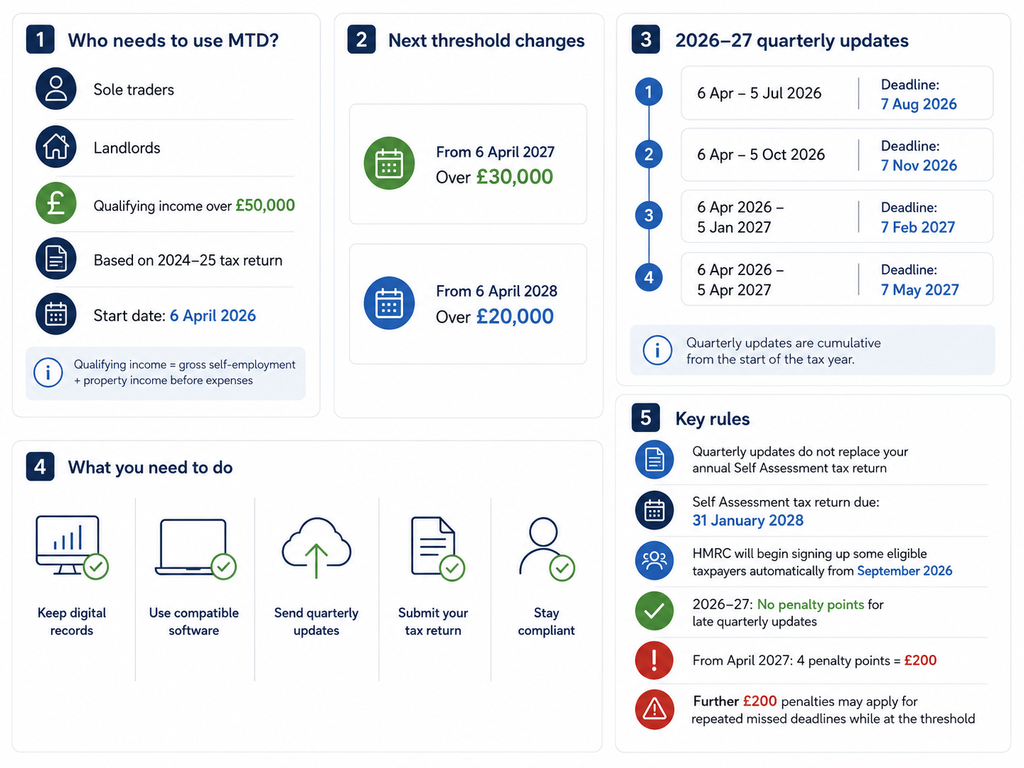
- The next start dates are 6 April 2027 for qualifying income over £30,000 in 2025–26 and 6 April 2028 for qualifying income over £20,000 in 2026–27.
- Quarterly updates are sent through compatible software and are cumulative. They do not replace the annual Self Assessment tax return.
- HMRC will not apply penalty points for late quarterly updates during 2026–27, but digital records and quarterly updates are still required.
- From September 2026, HMRC will start signing up people who need to use MTD for 2026–27 but have not already signed up, with enrolment taking place in stages.
What Is Making Tax Digital for Income Tax 2026?
Making Tax Digital for Income Tax requires qualifying sole traders and landlords to keep digital records and send quarterly updates to HMRC using compatible software. The updates provide HMRC with totals of self-employment and property income and expenses during the year, while the taxpayer still submits one annual Self Assessment tax return.
The obligation applies to people registered for Self Assessment who receive income from self-employment, property, or both and whose qualifying income exceeds the relevant threshold. HMRC’s official MTD eligibility guidance explains who needs to use the service and when.
MTD does not mean paying Income Tax four times a year. Quarterly updates are reporting obligations, not tax returns or payment demands. The normal Self Assessment payment timetable remains in place, with the full tax bill generally due by 31 January following the end of the tax year.
Who Must Use MTD for Income Tax and When?
You need to use MTD if you are a sole trader or landlord registered for Self Assessment, receive self-employment or property income, and your qualifying income is more than the relevant threshold for the tax year.
| Qualifying income used by HMRC | MTD start date | Practical position |
| More than £50,000 in 2024–25 | 6 April 2026 | The first mandatory group should already be using MTD |
| More than £30,000 in 2025–26 | 6 April 2027 | Preparation should begin before the 2027–28 tax year |
| More than £20,000 in 2026–27 | 6 April 2028 | The threshold widens the MTD population further |
Qualifying income is your total gross income from self-employment and property before expenses. If you have more than one relevant income source, those amounts are normally combined. HMRC explains the calculation in its guidance on working out qualifying income for MTD. You can also read Apex Accountants’ guide to Making Tax Digital income thresholds for a practical explanation of how the thresholds operate.
Partnerships do not currently need to use MTD for Income Tax as partnerships. HMRC says it will set out their timetable at a later date. A partner’s share of partnership profit also does not count towards that individual’s qualifying income, although their separate personal self-employment or property income may still bring them into scope.
Once you have started using MTD, falling below the threshold for one year does not automatically remove the obligation. HMRC says you can choose to opt out if your qualifying income remains below the relevant threshold for three tax years in a row. Different rules can apply if all self-employment or property income sources cease, so your position should be checked rather than assumed.
How Do Quarterly Updates Work for Sole Traders and Landlords?
Quarterly updates are totals of your self-employment and property income and expenses created from your digital records. HMRC’s current rules make these updates cumulative, meaning each update covers from the start of the tax year to the end of that update period. If you correct your digital records, the correction can flow through a later cumulative update without having to resend every earlier update.
For taxpayers using standard tax-year update periods, HMRC lists the following dates for 2026–27:
| Cumulative period covered | Quarterly update deadline |
| 6 April to 5 July 2026 | 7 August 2026 |
| 6 April to 5 October 2026 | 7 November 2026 |
| 6 April 2026 to 5 January 2027 | 7 February 2027 |
| 6 April 2026 to 5 April 2027 | 7 May 2027 |
You can check the full rules, including calendar update periods, in HMRC’s quarterly update guidance.
A quarterly update is only an in-year report. It does not complete your Self Assessment. After the end of the tax year, you still need to check the full-year information, make any necessary adjustments, add other income or gains, claim relevant reliefs and allowances, and submit your tax return through compatible software. For the 2026–27 tax year, the tax return and tax payment are due by 31 January 2028.
What Records and Software Do You Need?
You need digital records for the self-employment and property income and expenses covered by MTD. HMRC requires each digital income or expense record to include the:
- amount
- date the income was received or the expense was incurred
- relevant income or expense category
You must also continue keeping the supporting records you normally retain for Self Assessment, such as invoices and bank statements. HMRC’s guidance on creating digital records for MTD explains the detailed record-keeping requirements.
If you use more than one software product, the products used to create your digital records and make submissions must be digitally linked. If you use a single product for the whole process, no separate digital link between products is needed.
HMRC does not provide the bookkeeping software itself. You or your agent must use software that works with MTD for Income Tax to create and store records, send quarterly updates, and submit the annual tax return. You can review HMRC’s guidance on choosing MTD-compatible software or use its MTD software finder.
You can continue using spreadsheets, but a spreadsheet on its own cannot submit the required information to HMRC. You will need compatible bridging software or another compatible product that connects to the spreadsheet. If keeping digital records accurately is becoming difficult, Apex Accountants’ bookkeeping services can help keep income and expenses organised throughout the year.
What Happens If You Miss an MTD Deadline in 2026–27?
HMRC has confirmed that it will not apply penalty points for late quarterly updates during the 2026–27 tax year. You still need to keep digital records and send any outstanding quarterly updates before you can submit your tax return.
This temporary treatment only applies to quarterly update penalties. Penalty points can still apply to a late tax return, and separate late-payment rules apply if tax is not paid on time. HMRC’s MTD penalty guidance confirms that late-payment interest runs from the first day a payment is late.
For your first year under the new late-payment penalty regime, HMRC gives you 30 days from the payment due date to either pay in full or contact HMRC to arrange a payment plan before late-payment penalties start. This 30-day period is available only once; after the first year, the initial period reduces to 15 days.
For tax years after 2026–27, missed quarterly update deadlines can generate late-submission penalty points. The threshold for mandatory MTD quarterly obligations is four points. Reaching four points triggers a £200 penalty, and each further missed submission deadline while at the threshold can trigger another £200 penalty.

What Should You Do If You Are Not Ready for MTD?
If you are already in the first mandatory group:
- Check your qualifying income against the correct tax year.
- Confirm that your Self Assessment details and income sources are up to date.
- Choose compatible software or appoint an authorised tax agent.
- Reconcile bank transactions, self-employment income, rental income and expenses.
- Correct any inaccurate digital records and keep a clear audit trail.
- Send any outstanding quarterly update as soon as possible.
- Prepare for the next quarterly deadline rather than waiting until the filing date.
From September 2026, HMRC will start signing up people who need to use MTD for the 2026–27 tax year but have not already signed up. HMRC says this will happen in stages. If HMRC enrols you, its guidance explains what to do after HMRC has signed you up for MTD.
Even if you have not received a letter, you remain responsible for checking whether the rules apply to you.
Some taxpayers are exempt. This includes certain people who are digitally excluded, as well as a number of automatic and temporary exemption categories. HMRC’s MTD exemption guidance explains the current rules. Being exempt from MTD does not remove the requirement to report taxable income and gains through Self Assessment.
How Can an Accountant Help With MTD for Income Tax?
An accountant can check the threshold calculation, review mixed self-employment and property income, recommend suitable software, and create a process for keeping records and meeting each quarterly deadline.
This can be particularly useful where you have several income sources, jointly owned property, changing business activities, or records spread across different bank accounts and systems. A regular review can identify missing expenses, duplicated transactions and income assigned to the wrong activity before the figures reach HMRC.
Professional support can also help keep quarterly updates consistent with the final Self Assessment tax return and make sure adjustments and reliefs are dealt with at the correct stage.
How Apex Accountants Help
If you are a sole trader or landlord affected by Making Tax Digital for Income Tax 2026, the immediate priorities are confirming your threshold, setting up a compliant digital record-keeping process and preparing your next quarterly update.
Apex Accountants can help with:
- checking whether and when MTD applies to you
- software selection and setup
- digital record keeping and bookkeeping
- quarterly update preparation
- Self Assessment tax-return preparation
- ongoing deadline and compliance support
If you are unsure whether your current setup is ready, you can book a free consultation to review your position with Apex Accountants.
The Sensible Next Step
If you are a sole trader or landlord affected by Making Tax Digital for Income Tax 2026, confirm your qualifying income, check that your software and digital records meet HMRC requirements, and prepare for the next quarterly deadline now.
If you have missed an update or are unsure whether your records are accurate, deal with the issue while the 2026–27 quarterly-update penalty easement is still in place rather than allowing problems to build up before the next tax year.
Frequently Asked Questions
Can I Still Sign Up for MTD If I Missed the First Quarterly Deadline?
Yes. If you are required to use MTD and have not signed up yet, you should sign up and catch up with your digital records and quarterly updates as soon as possible. HMRC will not apply penalty points for late quarterly updates during 2026–27, but the reporting requirement still applies.
Does MTD Replace My Self Assessment Tax Return?
No. Quarterly updates are summaries, not tax returns. You still submit one Self Assessment tax return each tax year. Once you are using MTD, the return must be completed and submitted through compatible software by 31 January following the end of the relevant tax year.
Do Landlords With One Property Need MTD Software?
Possibly. The number of properties is not the test. A landlord may need MTD if their total qualifying income from property and self-employment exceeds the relevant threshold and the other conditions are met.
For UK property, HMRC generally treats one or more UK properties as a single UK property business for MTD record-keeping purposes.
What If My Income Is Close to £50,000?
Use your actual qualifying income rather than profit or a rounded monthly estimate. Qualifying income is generally the gross amount from self-employment and property before expenses, based on the relevant Self Assessment tax return. Include the relevant sources together when checking whether you exceed the threshold.
Do I Need an Accountant for Making Tax Digital for Income Tax 2026?
No. An accountant is not legally required. However, you do need compatible software and must meet the digital record-keeping, quarterly update and annual tax-return requirements if MTD applies to you. An accountant can help reduce the risk of software setup errors, incorrect categorisation and missed reporting obligations.
What Happens If I Get the Figures Wrong?
You should correct inaccurate digital records as soon as you identify the error. Because quarterly updates are cumulative, corrected records can be reflected in a later update without resending every earlier quarterly update. Before submitting your annual tax return, you should check that the full-year figures are correct and make any required adjustments.
Recent Posts
HMRC’s First Cryptoasset Statistics Show Why Records Matter
Capital Gains Tax is becoming increasingly important for UK crypto investors as HMRC gains access to more detailed information about...
Making Tax Digital for Income Tax 2026: What to Do Now
A sole trader may have completed the first MTD quarterly update without realising that the next deadline is already approaching....
MTD for Income Tax: What Sole Traders and Landlords Should Do After the First Deadline
A client came to Apex Accountants last week, a sole trader with two income streams, unsure whether she had met...
HMRC’s 436,000 MTD Milestone: What Sole Traders and Landlords Should Do Before September
We are increasingly asked the same question by clients who have heard about Making Tax Digital but are not sure...

HMRC Late Payment Interest Rate: What 7.75% Costs You
Miss a tax deadline today and HMRC charges 7.75% a year on the outstanding balance. The Bank of England’s base...

Electricity VAT Cut 2026: What the Six-Month Zero Rate Means from 1 October
The government’s announcement, made in July by new Prime Minister Andy Burnham as one of his first acts in office,...

What Happens to Your Personal Allowance Above £100,000 Income?
For UK taxpayers asking “What happens to my Personal Allowance if I earn over £100,000?”, the answer depends on HMRC’s...

Tax Codes: What Should You Put for Personal Allowances?
For UK employees, pensioners and employers asking, “What should I put for personal allowances?”, the answer depends on the person’s...

Complete Guide on First Making Tax Digital Quarterly Update Deadline 2026
We are increasingly hearing from sole traders and landlords who know that Making Tax Digital started in April but remain...

HMRC Landlord Tax Crackdown Recovers £100m in Unpaid Tax
A landlord can report rental income for several years and still discover that the figures do not match the rent...