
-
CALL US 0203 883 4777
MTD for Income Tax: What Sole Traders and Landlords Should Do After the First Deadline

A client came to Apex Accountants last week, a sole trader with two income streams, unsure whether she had met her first Making Tax Digital obligation correctly. She had filed her quarterly update on time, but when we reviewed her records, several property expenses were miscategorised and one invoice was duplicated. The submission was technically complete, but the figures feeding into her year-end tax return were already drifting.
This is the reality for many sole traders and landlords right now. HMRC says more than 436,000 people submitted their first quarterly update for 2026-27, and over 570,000 have signed up to the service. But submitting on time and getting the records right are two different things. If you are in scope of MTD for Income Tax, the work does not stop after the first deadline.
Key Takeaways
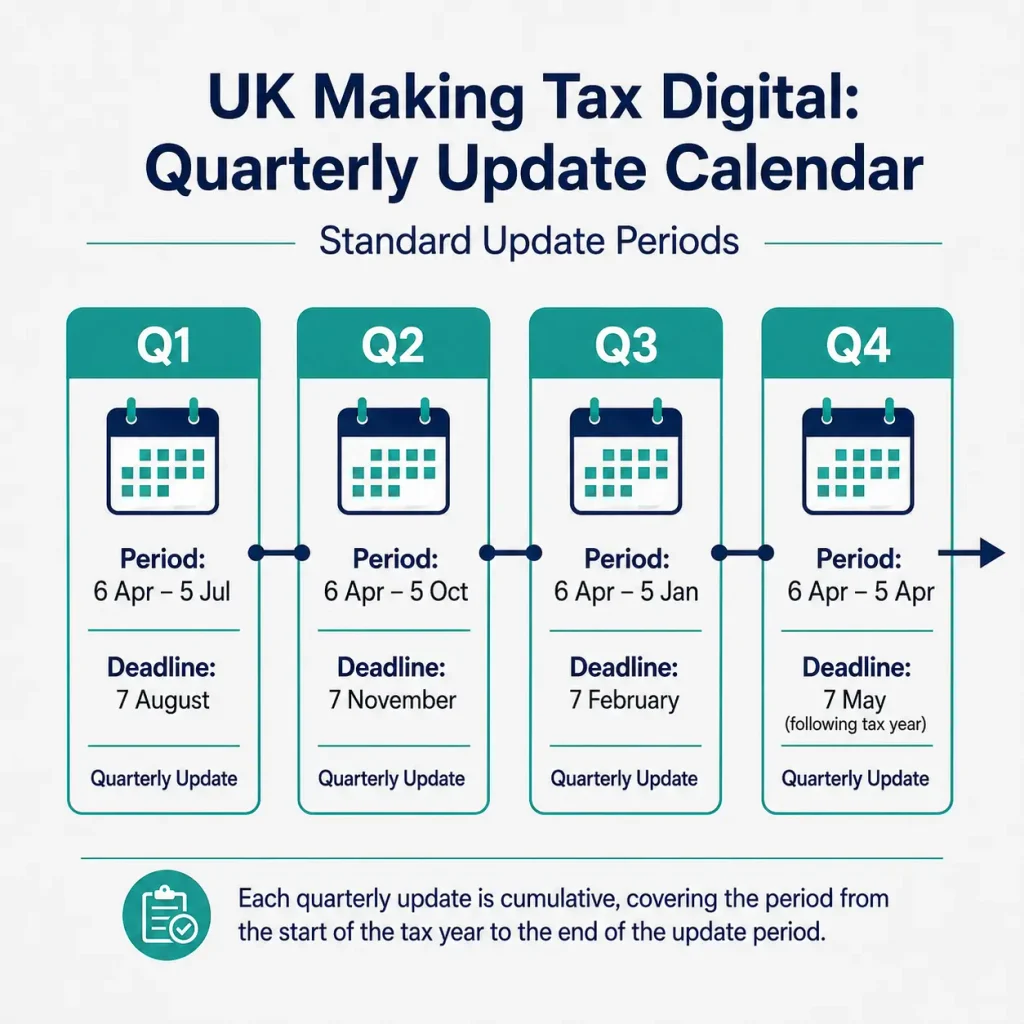
- First quarterly update deadline was 7 August 2026 – covering 6 April to 5 July 2026 (standard period)
- No penalty points for late quarterly updates during the 2026-27 tax year, but late Self Assessment returns and late payments still carry penalties
- Next quarterly update deadline: 7 November 2026 – covering 6 April to 5 October 2026
- From September 2026, HMRC will start signing up eligible taxpayers automatically if they have not signed up themselves
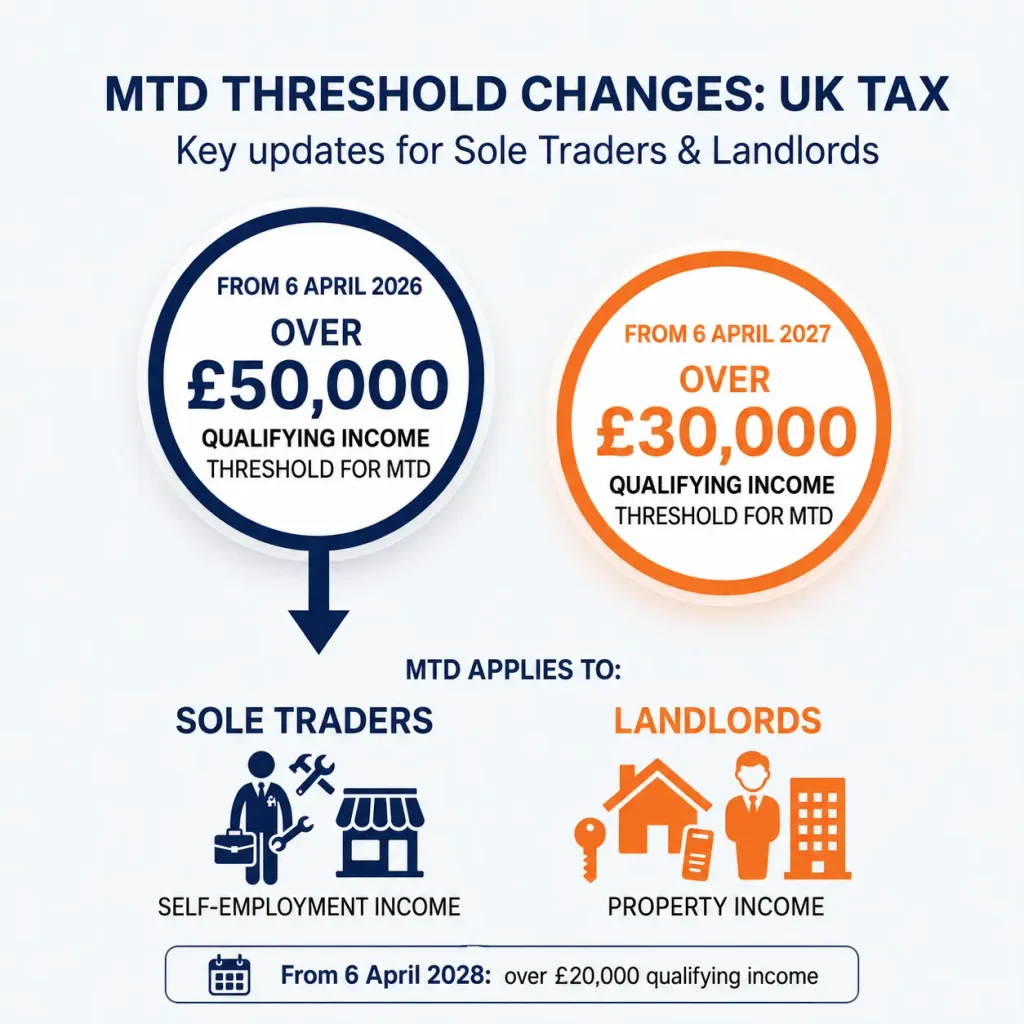
- From April 2027, MTD will apply to those with qualifying income over £30,000, down from over £50,000 for 2026-27
What happens after you submit your first MTD quarterly update?
After your first quarterly update is submitted through compatible software, HMRC has a summary of your income and expenses for that three-month period. You can view an estimate of your tax position through your software, and the figures you submitted will feed into your annual Self Assessment tax return. Nothing else is due immediately – the next action point is the second quarterly update, due by 7 November 2026.
However, the submission itself does not guarantee your records are accurate. If your digital records contain miscategorised expenses, duplicated entries, or missing income, those errors flow through to every subsequent update and into your final tax return. The best time to check is now, while the first period is fresh and corrections are straightforward. This is where professional bookkeeping services become valuable – ensuring your digital records are accurate from the start prevents compounding errors across all four quarterly updates.
What should you do if you missed the 7 August deadline?
If you missed the first quarterly update deadline, you should submit the outstanding update through your MTD-compatible software as soon as possible. HMRC has confirmed that no penalty points will be issued for late quarterly updates during the 2026-27 tax year, so there is no financial penalty for the delay – but the update is still legally required, and leaving it outstanding creates a larger backlog when the next deadline arrives.
The practical steps are:
- Open your MTD software and locate the missing quarterly update for the period 6 April to 5 July 2026.
- Review your digital records for that period – bank transactions, invoices, property income, expense receipts.
- Check that income and expenses are categorised correctly before submitting. If you use bookkeeping software that feeds into your MTD tool, verify the categories match.
- Submit the update through your software. HMRC will process it and update your tax position.
- Set a reminder for 7 November 2026 – the next quarterly update deadline.
If you are unsure whether MTD applies to you at all, check your qualifying income. The threshold for 2026-27 is over £50,000 from self-employment and property income combined. For a full breakdown of how the rules work, our Making Tax Digital services page explains the scope, thresholds, and what Apex Accountants does to keep clients compliant. You can also read our earlier guide on the rules for MTD for Income Tax for a deeper look at how quarterly updates interact with Self Assessment.
How do quarterly updates differ from the annual Self Assessment return?
Quarterly updates are short digital summaries of your income and expenses, sent every three months through MTD-compatible software. They are not tax returns, and no tax is payable because of a quarterly update. The annual Self Assessment tax return remains due by 31 January, and quarterly updates must be submitted to be able to file the final return.
The distinction matters because some taxpayers assume that filing quarterly updates means their tax return is done. It is not. The quarterly updates feed into the annual return, but you still need to review the full year, make any tax adjustments (capital allowances, private use adjustments, pension relief), and submit your tax return by 31 January 2028 for the 2026-27 tax year.
What are the MTD penalty rules for 2026-27 and beyond?
For the 2026-27 tax year, HMRC will not issue penalty points for late quarterly updates. This is a transitional arrangement to help taxpayers adjust to the new system. However, penalties for late Self Assessment returns and late tax payments still apply under the relevant rules – these are separate from the quarterly update penalty rules.
From 6 April 2027, a points-based penalty system will apply to missed quarterly deadlines. Taxpayers receive one penalty point for each missed quarterly deadline. Once four points are accumulated, a fixed £200 penalty is charged, and every further late submission after that triggers another £200 penalty. Points below the threshold expire automatically 24 months after the missed deadline. Once the threshold is reached, points reset to zero after quarterly updates and the tax return are submitted on time for 12 months and any outstanding quarterly updates and tax returns for the previous 24 months have been submitted.
When does HMRC start signing people up automatically?
From September 2026, HMRC will begin signing up customers who should be using MTD for Income Tax for the 2026-27 tax year but have not yet done so. This will happen in stages over the coming months. HMRC published guidance on 24 August 2026 explaining what taxpayers need to do if they receive confirmation that they have been signed up automatically.
Taxpayers who sign up themselves have the advantage of choosing their software, checking their details are correct from the start, and preparing in their own time. Waiting for HMRC to sign you up means you may have less control over the process and less time to prepare.
How can you prepare for the next quarterly update deadline?
The second quarterly update covers the period 6 April to 5 October 2026, with a deadline of 7 November 2026. To prepare, you should review your digital records monthly rather than leaving everything to the deadline. This gives you time to investigate unusual figures, confirm categorisations, and ensure your software is connected to the correct HMRC account.
If you have more than one income stream – for example, self-employment income and property income – you need to send a separate quarterly update for each self-employment and property business. If you are a landlord with rental properties, confirm that your property income and expenses are being recorded separately from any self-employment activity.
Checklist for the next deadline:
- Confirm your software is still connected to HMRC and recognised for MTD for Income Tax
- Review your records monthly for the cumulative period 6 April to 5 October 2026
- Check income categorisation – separate self-employment from property income if you have both
- Verify expense categories – ensure costs are allocated to the correct income source
- Submit before 7 November 2026 to stay ahead of the deadline
How Apex Accountants Help with MTD for Income Tax
The client mentioned at the start of this article is not unusual. Many sole traders and landlords have submitted their first quarterly update but are unsure whether their records are accurate, whether their categorisations are correct, or whether they are fully prepared for the next deadline. That is the gap we fill.
Our approach to MTD for Income Tax is practical, not theoretical. We start by reviewing your current software setup and digital records to identify any errors, miscategorisations, or gaps before they compound across quarterly updates. For clients with multiple income streams – particularly those with both self-employment and property income – we ensure each source is tracked separately and correctly allocated.
Specifically, we help with:
- Software selection and setup – we confirm your MTD-compatible software is correctly connected to HMRC and configured for your income sources
- Digital record review – we check your categorisations, identify duplicated entries, and correct errors from previous quarters
- Quarterly update preparation – we prepare and review each quarterly update before submission so your figures are accurate
- Year-end tax planning – we handle the adjustments (capital allowances, private use apportionments, pension relief) that quarterly updates do not cover
- Ongoing compliance – we track your deadlines, monitor threshold changes (including the move to qualifying income over £30,000 in April 2027), and keep you ahead of HMRC requirements
If you have submitted your first quarterly update and want to make sure your records are accurate before the next deadline, our Making Tax Digital services page explains exactly what we do. For broader support with digital record keeping and categorisation, our bookkeeping services are built around keeping your MTD submissions accurate throughout the year.

Frequently Asked Questions
Do I need an accountant for MTD quarterly updates?
You are not legally required to use an accountant for MTD, but many sole traders and landlords find professional support valuable – particularly if you have multiple income streams, property income, or complex expenses. An accountant can review your software setup, verify your categorisations, and ensure your quarterly figures are accurate so your year-end tax return is correct.
What happens if I get my quarterly update figures wrong?
If you discover an error after submitting a quarterly update, you can correct it in the next quarterly update. The figures are cumulative – each update builds on the previous one – so corrections made in a subsequent period will flow through to your annual return. However, it is better to get the figures right at source by reviewing your records regularly rather than relying on later corrections.
Will I be fined for submitting my first quarterly update late?
No. HMRC has confirmed that no penalty points will be issued for late quarterly updates during the 2026-27 tax year. This transitional arrangement means you will not face a points-based penalty for missing the 7 August deadline. However, you are still required to submit the update, and penalties for late Self Assessment returns and late tax payments still apply under the relevant rules.
How much does MTD-compatible software cost?
MTD-compatible software costs vary depending on the provider and the features you need. Some providers offer basic MTD-compliant packages for sole traders, while others charge more for features like automated bank feeds, receipt scanning, and multi-property tracking. HMRC publishes a list of compatible software on GOV.UK, which includes both free and paid options.
What if I have both self-employment and property income?
You need to send a separate quarterly update for each self-employment and property business. If you earn above the £50,000 threshold from combined self-employment and property income, you are in scope of MTD for Income Tax. The qualifying income calculation is based on gross income from these sources, not profit, so you need to check carefully whether you meet the threshold.
Does MTD apply if my income is below £50,000?
For the 2026-27 tax year, MTD for Income Tax applies to sole traders and landlords with qualifying income above £50,000. From April 2027, it will apply to those with qualifying income above £30,000. If your income is below the current threshold, you are not required to use MTD yet, but you may choose to sign up voluntarily to get ahead of the change.
Recent Posts

Can You Hold Crypto ETNs in an IFISA? What Stratiphy Means for UK Investors
The position is now much clearer. Retail access to certain crypto exchange-traded notes (crypto ETNs) in an IFISA was reopened...

7 Must-Have Features in Accounting Software for Car Rental Businesses
Running a car rental company in the UK involves far more than simply handing over keys to customers. From navigating...

All You Need to Know About Companies House Late Account Filing Penalties for Private, Public Companies and LLPs
Companies House late filing penalties remain a significant concern for private companies, public companies, and LLPs across the UK. Missing...

5 VAT Strategies For Car Garages To Use In 2026
Car garages face unique challenges when it comes to managing VAT efficiently, especially as the automotive sector continues to evolve....

6 Top VAT Compliance Case Studies and Key Lessons
Understanding VAT compliance can indeed be a tough challenge. Moreover, this is especially true with the varied challenges in different...

How the 182 Day Rule Wales Affects Welsh Farm Businesses
Holiday accommodation is vital to the Welsh rural economy. Yet the 2023 tax reforms introduced a steep 182‑day letting threshold...

Optimise Your Tax Position with VAT Planning Strategies for Different Schemes
Effective VAT Planning Strategies help businesses optimise their tax position, boost cash flow, and simplify VAT compliance. Below are some...

A Practical Guide to VAT for Advertising Design Companies in the UK
Understanding VAT for advertising design companies is essential for ensuring tax compliance and maximising your business’s financial efficiency. As a...

How Bookkeeping Helps Plumbers to Stay on Track
Plumbers spend their working days repairing leaks, clearing blocked drains and installing plumbing systems, leaving limited time for financial administration....

Zero-Rated VAT for Books in the UK: Tribunal Backs Publisher in Ghost-Written Book Dispute
A UK tax tribunal decision in Story Terrace Limited v HMRC [2025] UKFTT 01554 (TC), issued on 11 December 2025,...