
-
CALL US 0203 883 4777
HMRC’s 436,000 MTD Milestone: What Sole Traders and Landlords Should Do Before September

We are increasingly asked the same question by clients who have heard about Making Tax Digital but are not sure whether the deadline applies to them or what happens if they do nothing. The answer, as of August 2026, is straightforward: if you are a sole trader or landlord with qualifying income over £50,000 from self-employment or property shown on your 2024-25 tax return and you are not exempt, you are already legally required to use MTD for Income Tax – and from September, HMRC will start signing people up automatically if they have not done so themselves.
HMRC announced on 12 August 2026 that more than 436,000 sole traders and landlords have successfully submitted their first quarterly update under Making Tax Digital for Income Tax, with over 570,000 customers signed up to the service. That is a significant milestone, and HMRC has also confirmed that there are customers who need to use MTD but have not yet signed up – and HMRC is about to take matters into its own hands.
Key Takeaways
- 436,000+ sole traders and landlords have submitted their first MTD quarterly update
- 570,000+ customers have signed up to the MTD service
- From September 2026, HMRC will begin automatic sign-ups in stages for eligible taxpayers who have not signed up themselves
- Threshold for 2026-27: qualifying income over £50,000 from self-employment and property
- From April 2027: threshold drops to over £30,000 – more taxpayers will be brought into scope
- No penalty points for late quarterly updates during 2026-27, but late Self Assessment and late payment penalties still apply
What does the 436,000 figure actually mean?
The figure represents sole traders and landlords who successfully submitted their first quarterly update for 2026-27. HMRC published the figure in its 12 August announcement. The first quarterly update deadline was 7 August 2026. HMRC confirmed that the first quarterly update covered 6 April to 5 July 2026 for standard update periods. For calendar periods, it covered 1 April to 30 June 2026.
Separately, the 570,000 figure includes taxpayers who have registered for MTD. Some may not yet have submitted their first update. The gap between 436,000 submissions and 570,000 sign-ups suggests tens of thousands of people are registered but have not yet completed their first filing.
For more detail on the first reporting period and deadlines, see our guide to the first Making Tax Digital quarterly update deadline.
Who needs to sign up for MTD for Income Tax?
MTD for Income Tax applies to sole traders and landlords with qualifying income over £50,000 for the 2026-27 tax year. ‘Qualifying income’ means the gross income from self-employment and property – not profit. If you have multiple income sources, you need to add them together to check whether you exceed the threshold.
The threshold will change over the next year. It is over £50,000 for 2026-27 and drops to over £30,000 from April 2027. This means many more taxpayers will be brought into scope next year. If you are close to the current threshold, it is worth preparing now rather than waiting.
What happens when HMRC starts signing people up automatically in September?
From September 2026, HMRC will begin enrolling customers who need to use MTD for Income Tax. This applies to eligible taxpayers who have not yet signed up. This will happen in stages over the coming months.
HMRC published new guidance on 24 August 2026 explaining what taxpayers need to do after HMRC signs them up automatically.
The key difference between signing up yourself and being signed up by HMRC is control. If you sign up yourself, you choose your software, verify your details, and prepare on your own timeline. If HMRC signs you up, you may have less time to prepare and catch up on any outstanding requirements. For those who want to get their digital records right from the start, professional bookkeeping services can set up your software, categorise your income sources correctly, and ensure your first quarterly update is accurate.
What is a quarterly update and how is it different from a tax return?
A quarterly update is a short digital summary of your business income and expenses. You send it every three months through MTD-compatible software.It takes minutes to complete once your records are in order. It is not a tax return, and submitting an update does not create a tax payment. Your Self Assessment deadline of 31 January remains unchanged.
The quarterly updates feed into your annual tax return. When you come to file your Self Assessment, the income and expense information from your quarterly updates will feed into the year-end process. You then make any year-end adjustments (capital allowances, private use apportionments, pension relief) and submit the tax return.
Some taxpayers use calendar update periods instead. These are also cumulative: 1 April to 30 June, 1 April to 30 September, 1 April to 31 December, and 1 April to 31 March. The deadline for all customers is the same regardless of which period they use.
For a deeper look at how quarterly updates work alongside Self Assessment, read our earlier guide on the rules for MTD for Income Tax.
What are the penalties for not complying with MTD?
For the 2026-27 tax year, HMRC has confirmed that it will not issue penalty points for late quarterly updates. This is a transitional arrangement to help taxpayers adjust. However, penalties for late Self Assessment tax returns and late tax payments still apply – these are separate systems.
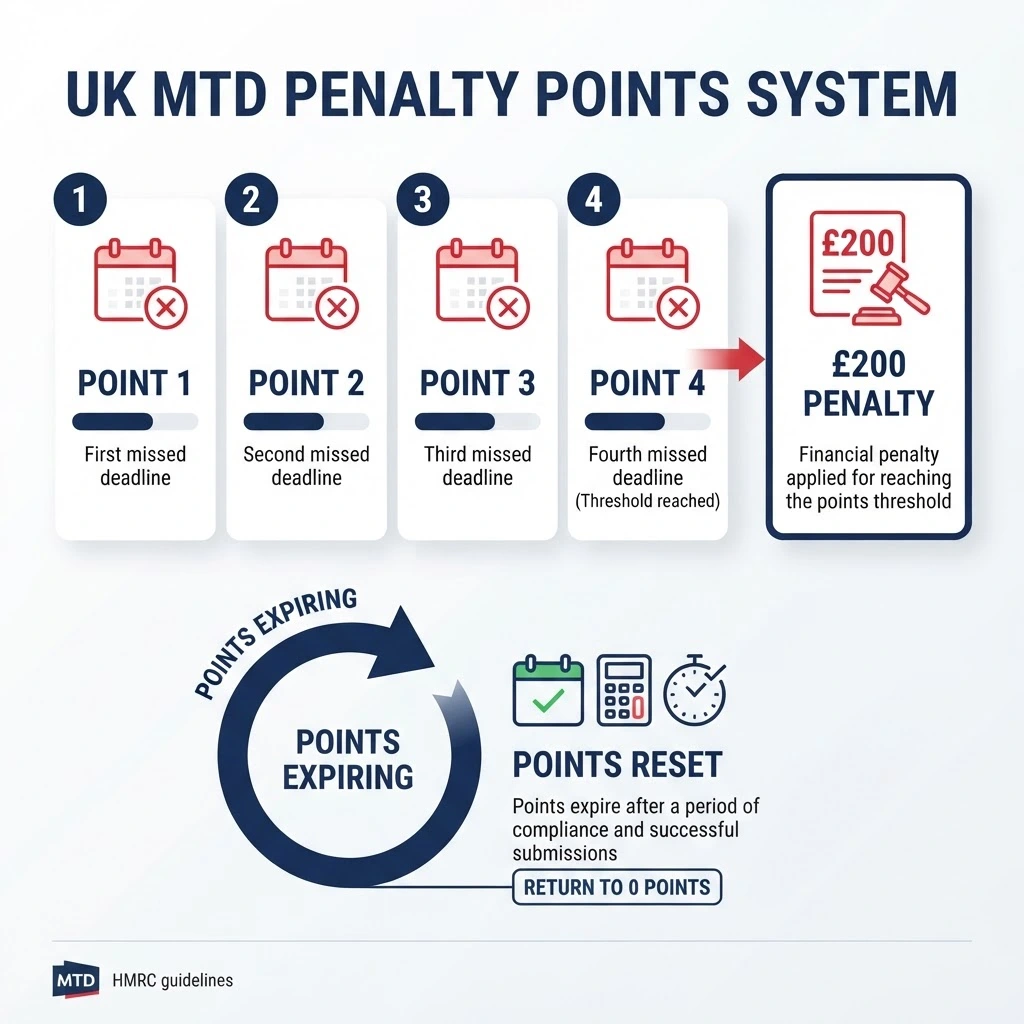
From 6 April 2027, a points-based penalty system will apply to missed quarterly deadlines: one point is given for each missed quarterly update deadline, and four points trigger a fixed £200 penalty. A further £200 penalty can apply for each additional missed submission while you remain at the penalty threshold.
If you are below the four-point threshold, individual penalty points normally expire 24 months after the missed deadline. Once you reach the threshold, the points do not simply expire after a period of compliance. To reset them, you generally need to meet your filing deadlines for 12 months. You must also submit outstanding quarterly updates and tax returns from the previous 24 months.
This means the 2026-27 tax year provides a grace period for quarterly update penalty points – but not for late tax returns or late tax payments. Use this year to get your systems right so you are not accumulating points from April 2027 onwards.
How do you choose the right MTD-compatible software?
Choose MTD-compatible software that HMRC recognises. It must also submit quarterly updates directly to HMRC’s systems.
When choosing software, consider:
- Number of income sources – if you have both self-employment and property income, confirm the software supports multiple income streams
- Bank feeds and automation – some packages connect directly to your bank to import transactions
- Property-specific features – landlords with multiple properties may prefer software that allows individual properties to be tracked separately
- Agent access – if you use an accountant, check whether the software allows your agent to access and review your records
- Cost – basic packages may be sufficient for simple sole traders, while complex income structures may need more advanced features
Are there any exemptions from MTD for Income Tax?
Yes. HMRC provides various exemptions from MTD for Income Tax, including for taxpayers who are digitally excluded. Other exemptions may apply based on specific circumstances. If you believe you may be exempt, you should check HMRC’s exemption guidance and, if necessary, seek professional advice rather than assuming you are outside the scope of the rules.
The Apex Accountants View: Why Acting Before September Matters
We have been preparing clients for Making Tax Digital for Income Tax since the rules were first announced. We consistently see better results among clients who prepare early. Those who sign up themselves also have more time to organise their records before HMRC enrols them. The 436,000 figure shows that the system is working. However, there is still a substantial gap between the 436,000 submissions and 570,000 sign-ups. Thousands of people have registered but have not yet filed. HMRC has also confirmed that some eligible customers have not signed up.
Our recommendation is simple: if you think you are in scope, act now. Do not wait for HMRC to send you a letter in September. Signing up yourself gives you more control over the process. You can choose your software, organise your digital records, and check your categorisations before the next deadline. Waiting means you lose some of that preparation time.
Here is what we do for clients who come to us at this stage:
- Eligibility assessment – we calculate your qualifying income across all sources to confirm whether you are in scope, including the over £50,000 threshold for 2026-27 and the over £30,000 threshold from April 2027
- Software selection – we help you choose MTD-compatible software that fits your income structure, whether you are a sole trader, landlord, or both
- Digital record setup – we configure your software with the correct income categories, expense types, and property tracking if applicable
- First quarterly update support – we prepare and review your first quarterly update to ensure accuracy from the start, preventing compounding errors
- Ongoing MTD compliance – we track your deadlines, monitor threshold changes, and keep you ahead of HMRC requirements throughout the year
If you have not yet signed up for MTD, or you are unsure whether the threshold applies to you, our Making Tax Digital services page explains what we do in detail. For clients who need help getting their digital records in order before signing up, our bookkeeping services cover everything from software setup to ongoing categorisation.

Frequently Asked Questions
Do I need an accountant to sign up for MTD?
You can sign up for MTD yourself through GOV.UK, without needing an accountant. However, professional support may help if you have multiple income streams or complex expenses. It can also save time if you are unsure whether you meet the qualifying income threshold. An accountant can also help you choose the right software and set up your digital records correctly from the start.
What happens if HMRC signs me up and I was not expecting it?
If HMRC signs you up automatically, you will receive communication explaining what you need to do. HMRC published guidance on 24 August 2026 for taxpayers who are signed up automatically. You will need to get MTD-compatible software, set up or update your digital records, and submit any outstanding quarterly updates. Acting before September gives you more time to prepare on your own terms.
Is qualifying income the same as profit?
No. HMRC calculates your qualifying income using your gross income from self-employment and property. This means your turnover before expenses. Profit is what remains after deducting allowable expenses. You could have a profit below £50,000 but still be in scope of MTD if your gross income exceeds the threshold. This is a common source of confusion, so check the calculation carefully.
What if my income fluctuates above and below £50,000?
HMRC uses your qualifying income from the relevant previous tax return to determine when you enter MTD. If your qualifying income exceeded £50,000 in 2024-25, you must use MTD for 2026-27. An exemption or another relevant rule may exclude you. Your circumstances may change after you start using MTD. If your qualifying income stays below the relevant threshold for three consecutive tax years, you may be able to opt out. You should check HMRC guidance rather than assuming that falling below the threshold for one year automatically takes you out of MTD.
Can I use MTD voluntarily if my income is below £50,000?
Yes. If you are eligible, you can sign up voluntarily for MTD for Income Tax even if your income is below the current mandatory threshold. Voluntary sign-up can help you get used to the system before MTD becomes mandatory for you. This may be useful if your income is close to £50,000. It may also help if the lower threshold from April 2027 is likely to bring you into scope.
How much does it cost to get help with MTD setup?
The cost of professional MTD support depends on your circumstances. Your income structure, number of income sources, and record complexity can all affect the price. A consultation with Apex Accountants will give you a clear assessment of what you need and a fixed quote based on your specific circumstances.
Recent Posts

Understanding VAT on Holiday Lets: The £90,000 Question for Landlords
You do not need to register for VAT on holiday lets until your taxable turnover from the properties passes £90,000...

What the Glasgow Restaurant VAT Fraud Case Teaches About Tax Compliance
In a recent case in Glasgow, two restaurant owners were found guilty of carrying out nearly a £700,000 VAT fraud...

What You Need to Know About VAT Exemption for Cultural Services
For UK-based arts and culture organisations, the rules on VAT exemption for cultural services are very important. At Apex Accountants,...

HMRC Compliance Check vs Tax Investigation: What Is the Difference?
An HMRC compliance check and a tax investigation are not always two separate procedures. “Compliance check” is HMRC’s broad term...

Popular Financial Reporting Tools For 2026/27
Choosing the right financial reporting tools can help businesses improve the accuracy, speed and usefulness of their financial information. In...

Will IR35 Be Scrapped? The IR35 Changes and Replacement Pledge Explained
IR35 remains fully in force. The off-payroll rules still apply in full, and HMRC still expects a status determination for...

Off-Payroll IR35: What Are the Rules and How Do They Apply?
The off payroll IR35 rules, commonly known as IR35, apply to certain contractors who provide their services through an intermediary,...

Non-UK Directors Tax: What UK Companies Need To Know
Appointing a director who lives overseas can be a smart move. You gain experience, contacts, and strategic oversight. However, non-UK...

VAT Rules for Education Consultancies Made Simple for UK and International Student Support Providers
Understanding VAT rules for education consultancies is essential for any organisation that supports students with admissions, training, visa processing, or...

Employment Allowance UK: Employer NIC Relief Explained
Employment Allowance UK can reduce an eligible employer’s secondary Class 1 National Insurance contributions by up to £10,500. For businesses...