
-
CALL US 0203 883 4777
Director Tax Return 2025/26: New Self Assessment Rules for Close Company Directors

If you run an owner-managed or family company, your director tax return 2025/26 asks for more information than ever before. From the 2025/26 tax year, HMRC requires company directors to report the company name, its registration number, the dividends they received from that company and their highest shareholding percentage. The tax you pay does not change, but every missing item can cost £60, and the details you provide now let HMRC cross-check your return against your company’s accounts. The return is due by 31 January 2027 online. Here is exactly who the rules catch, what to report and what to do before you file.
Key takeaways
- Company directors must complete new mandatory boxes on the employment pages from the 2025/26 return.
- For each company you direct, report the company name, Companies House registration number, dividends received from it (enter 0 if none) and your peak shareholding percentage.
- You need a separate employment page for every directorship you held during the year.
- File online by 31 January 2027 (31 October 2026 on paper).
Who Do the New Rules Apply To?
The rules apply to directors of close companies who already complete a Self Assessment return. If HMRC already expects a return from you and you direct a close company, the new boxes apply to you. Any director in that position, paid or unpaid, is caught by the new reporting.
A close company, in simple terms, is a UK company controlled by five or fewer participators, or by any number of participators who are also directors. Participators include shareholders and anyone with a share in the company’s capital or income, including people entitled to distributions or benefits from it. That definition covers most owner-managed, family-owned and privately held businesses in the UK, so the vast majority of owner-managed companies fall inside it.
The rules reach further than directors formally registered at Companies House. They can also apply to people who act as directors without being formally appointed, including those falling within the relevant definition of a shadow director. Even unpaid directors of dormant close companies must complete the new boxes if they are already required to file a Self Assessment return.
What Exactly Changed on the Director Tax Return SA102 Pages?
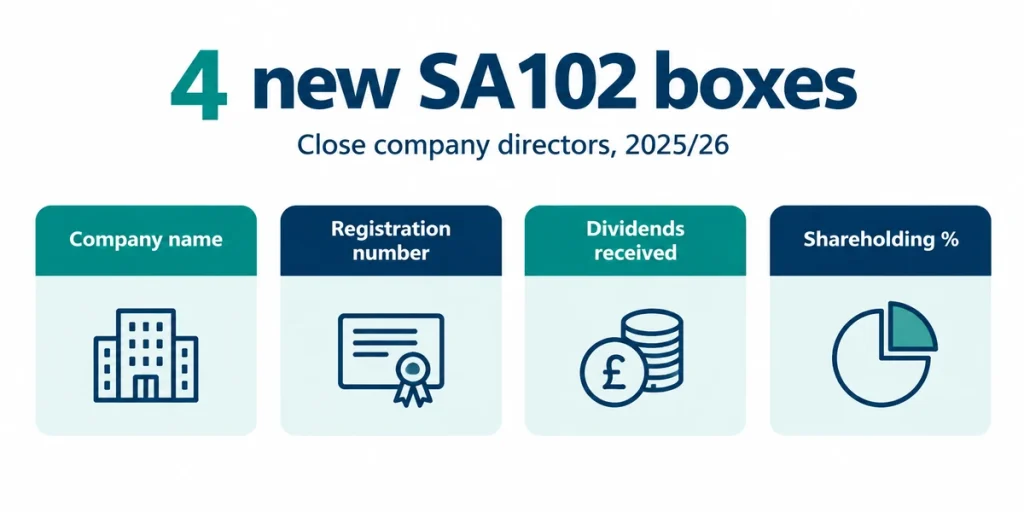
Before this year, the pages asked optional questions about directorships.From the 2025/26 return, close company questions carry mandatory additional information requirements. For each close company where you held a directorship at any point during the tax year, you must report four things on your director tax return:
- The company’s full name (box 7.1).
- Its Companies House registration number (box 7.2).
- The dividends you received from that company during the year (box 7.3), including nil. If you took nothing out, you enter 0, not a blank. This figure must match the dividend income on your main return.
- Your highest percentage of ordinary share capital at any point in the year (box 7.4). If your shareholding changed, report the peak, not the end-of-year figure.
Alongside these new reporting requirements, directors should also review their salary and dividend planning for 2026/27 to structure future withdrawals efficiently and consider the wider impact on both their personal and company tax position.
You also complete a separate page for each directorship, so a director with two companies files two sets of employment pages. Dividends from close companies are now separated from your other UK dividend income on the main SA100 return, which makes the cross-check between your company accounts and your personal return automatic.
Worked Example: Two Companies, One Return
Priya is a director of two close companies. She holds 60% of A Ltd and took £40,000 in dividends from it during 2025/26. She holds 25% of B Ltd and took nothing from it.
Her Self Assessment return requires a separate employment page for each directorship. For A Ltd, she enters the company name and registration number, £40,000 in dividends and a 60% shareholding. For B Ltd, she enters the company name and registration number, £0 in the dividend box and a 25% shareholding.
On her main return, the £40,000 sits in the dividend income section, and the 2025/26 dividend tax rules apply to it. Directors should consider reviewing how dividends interact with salary, allowances and their wider personal tax position. After the £500 Dividend Allowance, £39,500 of her dividend income remains taxable:
| 2025/26 tax band | Dividend tax rate |
| Dividend allowance (first £500) | 0% |
| Basic rate | 8.75% |
| Higher rate | 33.75% |
| Additional rate | 39.35% |
If her other taxable income has already used all of her basic-rate band, and the full £39,500 of dividends above the £500 Dividend Allowance falls within the higher-rate band, she owes approximately £13,331.25 in dividend amount of tax (£39,500 × 33.75%).
What Should Close Company Directors Do Before Filing?
Four preparations make the new reporting straightforward:
- Gather every dividend voucher and board minute for each company you direct, so the dividend figure you report matches your records.
- Confirm your shareholding percentage for the year, including the peak if you transferred or issued shares mid-year. Alphabet shares and mid-year changes need careful calculation of the highest holding.
- Complete your Companies House identity verification so a mismatch does not delay your return.
- Reconcile your personal return against your company accounts before filing. The whole point of the new boxes is that HMRC can now compare the two automatically, so they must agree.
What Happens If You Get the New Boxes Wrong?
The new reporting requirement does not carry a separate filing charge, although taxpayers may incur software or professional-adviser costs. HMRC may charge a £60 penalty for failure to comply with the additional information requirement, regardless of the number of directorships or missing items. Standard accuracy penalties may also apply where an inaccurate return results in tax being understated and the relevant penalty conditions are met.
The context matters too. HMRC links the change to the tax gap, where small businesses account for a large share of missing revenue, and to transactions between companies and their owners. Because every close director in the company now discloses company-level details, HMRC can spot undeclared dividends and inconsistent records immediately. The professional bodies agree on the substance: the ICAEW and the ATT have both published member guidance on the new requirements.

When Are the 2025/26 Deadlines?
The 2025/26 return covers income from 6 April 2025 to 5 April 2026.Directors who still need to register should also check the Self Assessment registration deadline before preparing their return.
Key dates:
- 31 October 2026: paper return deadline.
- 31 January 2027: online return deadline.
- 31 January 2027: payment of any tax due.
Directors who prepare dividend paperwork and shareholding records now avoid a January scramble with the new boxes.
Frequently Asked Questions
Do I complete the new boxes if I received no dividends?
Yes. You enter 0 in the dividend box for each close company you direct. Leaving it blank counts as a missing item.
I am an unpaid director of a dormant close company. Do the rules apply to me?
Yes, if you already complete a Self Assessment return. Director status, not income, triggers the reporting.
Does every directorship need its own employment page?
Yes. Each directorship you held at any point in the year requires a separate set of employment pages.
Does this change the dividend on tax I pay?
No. The rules change what you report, not what you owe. Your tax on divident and other liabilities follow the existing 2025/26 rates.
What if my shareholding changed during the year?
You report the highest percentage you held at any point in the tax year in box 7.4.
How Apex Accountants Can Help
We prepare proper Self Assessment returns for directors every January, and the new close company boxes are now a standard part of that service. Our team cross-checks your personal return against your company accounts so the dividend figures, shareholding percentages and registration numbers agree before anything reaches HMRC.
We maintain your dividend vouchers and board minutes through our bookkeeping and company accounts services, handle salary and dividend planning for the 2026/27 year ahead, and manage multiple directorships in one place. If you direct a close company and want the 2025/26 return handled properly, contact Apex Accountants and we will take the paperwork off your desk.
Recent Posts
Director Tax Return 2025/26: New Self Assessment Rules for Close Company Directors
If you run an owner-managed or family company, your director tax return 2025/26 asks for more information than ever before....

Business Rates Relief 2026: Could the Threshold Increase?
The current relief thresholds have not changed. Business rates relief 2026 has not adopted a £17,096 exemption threshold. A newspaper...

Taking Money Out of Your Company: 2026 Rule Changes Explained
On 14 September 2026, HMRC closed its consultation on modernising the taxation of distributions and repayments of capital from companies....

Is the UK Tax System Too Complex for Small Businesses in 2026?
For many small businesses, keeping up with tax now means managing several filing cycles, digital reporting requirements and separate payment...

How the UK Exit Tax Proposal Could Introduce a 20% Charge for Individuals and Businesses
The proposed UK exit tax is a one-off charge, reported at around 20%, on unrealised gains in UK business and...

Payrolling Benefits in Kind: What Employers Must Do by 2027
From 6 April 2027, the way UK employers report some benefits in kind will change significantly. Company cars, car fuel,...
UK Wealth Tax: Would Business Owners and High Earners Pay?
Owning a valuable business does not necessarily mean having substantial cash available personally. Equally, earning a high salary does not...

Self Assessment Registration Deadline: What to Do Before 5 October 2026
We’re increasingly asked by clients who started trading during 2025/26: “Do I need to register for Self Assessment?” It’s a...

R&D Tax Relief 2026: New HMRC Rules and How to Claim Successfully
We’re seeing more companies come to us after having their R&D tax relief claims questioned, returned, or rejected by HMRC....

HMRC Auto-Registration for MTD: What Happens If You Don’t Sign Up First
Sole traders and landlords are increasingly asking what happens if they do not respond to Making Tax Digital sign-up letters....