
-
CALL US 0203 883 4777
Is the UK Tax System Too Complex for Small Businesses in 2026?

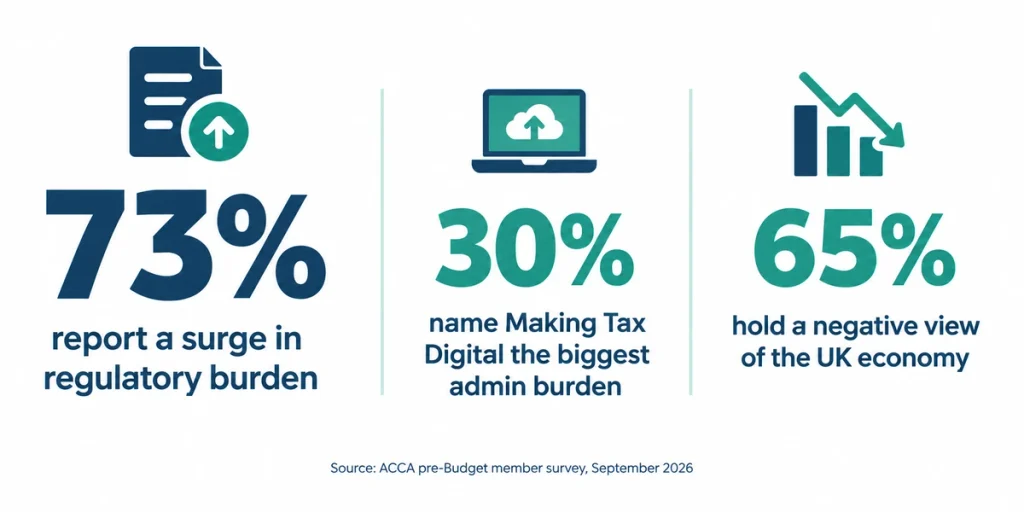
For many small businesses, keeping up with tax now means managing several filing cycles, digital reporting requirements and separate payment deadlines at the same time. A September 2026 member survey by ACCA, which represents more than 100,000 UK members, found that 73% of respondents said their regulatory requirements had surged over the previous 12 months. Making Tax Digital (MTD) was named the single biggest negative administrative burden by 30%.
The survey does not change any tax rules. However, it highlights a wider issue for small businesses: tax complexity carries a practical cost in time, systems and the risk of missed obligations.
Key Takeaways:
- 73% of ACCA respondents said regulatory requirements had increased sharply over the previous 12 months.
- Making Tax Digital was the biggest single administrative concern, cited by 30%, followed by reporting duplication at 10% and wider regulatory complexity at 8%.
- MTD for Income Tax became mandatory from April 2026 for qualifying sole traders and landlords with income above £50,000.
- There is currently no planned MTD for Corporation Tax rollout. Corporation Tax is being modernised separately.
- A central compliance calendar, accurate digital records and suitable accounting software can reduce the risk of deadlines being overlooked.
What Did the ACCA Survey Find?
ACCA surveyed its UK members ahead of the next Budget to understand the pressures affecting businesses and the profession.
Alongside the 73% reporting increased regulatory requirements, 65% of respondents held a negative view of the UK economy, while only 4% were positive. The comparable positive figure was 29% in 2023.
When respondents were asked about administrative burdens, 30% selected Making Tax Digital as the biggest negative burden with little end-user benefit. General reporting duplication followed at 10%, systemic regulatory complexity at 8%, upcoming employment law changes at 7%, and Companies House verification processes at 7%.
There was some improvement in attitudes towards HMRC service levels. In August 2024, 89% of respondents said HMRC service problems negatively affected their organisation’s productivity and efficiency. By August 2026, that figure had fallen to 54%, although it still represented more than half of respondents.
ACCA has called for a wider review of the tax system and argued that simplifying tax administration could reduce errors and compliance costs while giving businesses greater certainty. These are recommendations to the government rather than confirmed changes to the rules businesses currently follow.
Why Is the UK Tax System So Complex for Small Businesses?
One reason is that businesses rarely deal with a single tax obligation.
A limited company may need to manage Corporation Tax, VAT, PAYE, National Insurance, benefits in kind, Companies House filings and, depending on the director’s circumstances, personal Self Assessment. Sole traders can face their own combination of trading income, property income, VAT and Self Assessment requirements.
Each regime also works to a different timetable. Understanding whether you need to register for Self Assessment is only one part of the picture, while limited companies must separately keep track of their Corporation Tax payment and filing deadlines.
Employers add another reporting cycle because payroll information generally has to be reported to HMRC on or before employees are paid. For businesses without an internal payroll function, outsourcing payroll administration can also reduce the number of recurring compliance tasks handled by the owner.
The difficulty is therefore not necessarily one individual deadline. It is keeping several different systems, dates and reporting requirements aligned throughout the year.
How Does Making Tax Digital Add to the Burden?
Making Tax Digital requires affected taxpayers to maintain digital records and use compatible software to make specified submissions.
MTD for VAT has applied to VAT-registered businesses for several years. MTD for Income Tax entered its mandatory phase on 6 April 2026 for sole traders and landlords whose qualifying income from self-employment and property exceeded £50,000 on their 2024/25 tax return.
Under the current MTD for Income Tax timetable, the threshold falls to more than £30,000 from April 2027 and more than £20,000 from April 2028.
For taxpayers who entered MTD for Income Tax in April 2026, the quarterly submission deadlines for the 2026/27 tax year are:
- 7 August 2026
- 7 November 2026
- 7 February 2027
- 7 May 2027
The first MTD quarterly update therefore had a fixed deadline of 7 August 2026 rather than a date individually set when a taxpayer joined.
HMRC has also confirmed that penalty points will not be applied for late quarterly updates during the 2026/27 tax year. Quarterly updates must still be submitted before the taxpayer can complete their annual tax return.
Importantly, businesses should not assume the same MTD model is being extended to Corporation Tax. HMRC’s current transformation programme says MTD will not be introduced for Corporation Tax. Instead, the Corporation Tax system and company tax return process are being modernised separately.
What Tax Deadlines Does a Small Business Face?
A typical small business can deal with several different deadlines during the same year.
| Obligation | Typical Deadline | Frequency |
|---|---|---|
| Self Assessment online return and balancing payment | 31 January | Annual |
| VAT return and payment | Usually 1 month and 7 days after the VAT period ends | Usually quarterly |
| Corporation Tax payment | Usually 9 months and 1 day after the accounting period ends | Annual |
| Company Tax Return | Usually 12 months after the accounting period ends | Annual |
| Private company accounts to Companies House | Usually 9 months after the company year end | Annual |
| PAYE reporting | On or before each payday | Each pay run |
| PAYE and NIC payment to HMRC | Usually by the 22nd of the following month when paying electronically | Monthly or quarterly |
| MTD for Income Tax quarterly update | 7 Aug, 7 Nov, 7 Feb and 7 May for 2026/27 | Quarterly |
| P60 | Given to eligible employees by 31 May | Annual |
| P11D, where applicable | 6 July following the end of the tax year | Annual |
The exact dates can vary according to the business and its circumstances. The broader problem is that several obligations can overlap, particularly for businesses that are VAT registered, employ staff and operate through a limited company.
What Happens If You Get It Wrong?
Different taxes have different penalty regimes, so it is important not to treat them as interchangeable.
Under the current Self Assessment late-filing rules, an online return filed after its deadline normally attracts an initial £100 penalty. If it remains outstanding for more than three months, additional daily penalties of £10 can apply for up to 90 days. Further penalties can arise after six and 12 months.
VAT operates differently. A late VAT return normally results in a penalty point. Once the relevant points threshold is reached, a £200 financial penalty can apply, with additional £200 penalties for subsequent late submissions while the business remains at the threshold.
Late private-company accounts filed at Companies House can attract a £150 penalty when they are up to one month late, with the amount increasing the longer the delay continues. Corporation Tax, VAT and other late tax payments can also attract interest and, depending on the regime, additional late-payment penalties.
For MTD for Income Tax, the position is different again. HMRC has introduced a points-based system, but it has confirmed that late quarterly updates will not receive penalty points during the 2026/27 tax year.

How Can Small Business Owners Cut the Admin Burden?
You cannot control the number of UK tax rules, but you can make your own compliance process easier to manage.
- Keep one compliance calendar. Put your VAT, Corporation Tax, Companies House, payroll, Self Assessment and MTD dates in the same system rather than monitoring them separately.
- Use compatible accounting software. Keeping records digitally throughout the year is much easier than reconstructing transactions immediately before a reporting deadline.
- Review obligations before thresholds are crossed. VAT registration, MTD and other requirements can change as turnover or qualifying income grows.
- Keep business and personal records separate. A dedicated business account and consistent bookkeeping make transactions easier to classify and reconcile.
- Decide which tasks should stay in-house. Some businesses can manage straightforward bookkeeping themselves, while others may find that outsourcing accounting work makes more sense once VAT, payroll, company filings and tax returns begin to overlap.
Frequently Asked Questions
Is the UK tax system too complicated for small businesses?
There is no single objective measure of whether a tax system is “too complicated”, but ACCA’s September 2026 survey shows significant concern among accountancy professionals. Some 73% of respondents reported a surge in regulatory requirements, while MTD, duplicated reporting and wider regulatory complexity were among the most commonly cited administrative burdens.
What is the biggest admin burden for small businesses?
In ACCA’s survey, Making Tax Digital was the most frequently selected negative administrative burden, cited by 30% of respondents. Reporting duplication followed at 10% and wider regulatory complexity at 8%.
Do small businesses have to use Making Tax Digital?
MTD for VAT applies to VAT-registered businesses unless an exemption applies. MTD for Income Tax is being phased in according to qualifying income from self-employment and property. It became mandatory from April 2026 for qualifying income above £50,000, with thresholds of more than £30,000 from April 2027 and more than £20,000 from April 2028.
Can I reduce tax admin without hiring an accountant?
Yes. Good bookkeeping, compatible software, a central deadline calendar and regular reconciliations can significantly reduce routine administration. Professional support may become more useful where several taxes overlap, the business is growing, or decisions require tax judgement rather than simple data entry.
What happens if I miss a Self Assessment deadline?
Under the ordinary Self Assessment late-filing rules, the initial penalty is normally £100. Additional daily penalties can begin after three months, with further charges after six and 12 months. Filing the outstanding return and paying any tax due as soon as possible can prevent further penalties and interest from accumulating.
How Apex Can Help
Managing several tax obligations at once can take attention away from running your business. Our outsourced accounting support can bring bookkeeping, VAT, payroll, year-end accounts and tax compliance into a more coordinated process.
If Making Tax Digital is creating additional work, we can help set up compatible cloud accounting, maintain digital records and keep quarterly submissions organised throughout the year.
Compliance is only one side of the picture. Effective business tax planning can also help you make appropriate use of available allowances and reliefs while keeping your approach within current UK tax rules.
If you have already missed a deadline or received a penalty, we can review the position, identify any available grounds for an appeal and help bring outstanding filings back up to date.
Book a free consultation, and we can map your business’s main tax and filing deadlines into one practical compliance plan.
Recent Posts

What Happens If You Miss the Self Assessment Deadline in 2027?
If you need to file a tax return for the 2025/26 tax year, the self-assessment deadline is 31 January 2027....

Can You Hold Crypto ETNs in an IFISA? What Stratiphy Means for UK Investors
The position is now much clearer. Retail access to certain crypto exchange-traded notes (crypto ETNs) in an IFISA was reopened...

7 Must-Have Features in Accounting Software for Car Rental Businesses
Running a car rental company in the UK involves far more than simply handing over keys to customers. From navigating...

All You Need to Know About Companies House Late Account Filing Penalties for Private, Public Companies and LLPs
Companies House late filing penalties remain a significant concern for private companies, public companies, and LLPs across the UK. Missing...

5 VAT Strategies For Car Garages To Use In 2026
Car garages face unique challenges when it comes to managing VAT efficiently, especially as the automotive sector continues to evolve....

6 Top VAT Compliance Case Studies and Key Lessons
Understanding VAT compliance can indeed be a tough challenge. Moreover, this is especially true with the varied challenges in different...

How the 182 Day Rule Wales Affects Welsh Farm Businesses
Holiday accommodation is vital to the Welsh rural economy. Yet the 2023 tax reforms introduced a steep 182‑day letting threshold...

Optimise Your Tax Position with VAT Planning Strategies for Different Schemes
Effective VAT Planning Strategies help businesses optimise their tax position, boost cash flow, and simplify VAT compliance. Below are some...
A Practical Guide to VAT for Advertising Design Companies in the UK
Understanding VAT for advertising design companies is essential for ensuring tax compliance and maximising your business’s financial efficiency. As a...

How Bookkeeping Helps Plumbers to Stay on Track
Plumbers spend their working days repairing leaks, clearing blocked drains and installing plumbing systems, leaving limited time for financial administration....