
-
CALL US 0203 883 4777
Payrolling Benefits in Kind: What Employers Must Do by 2027

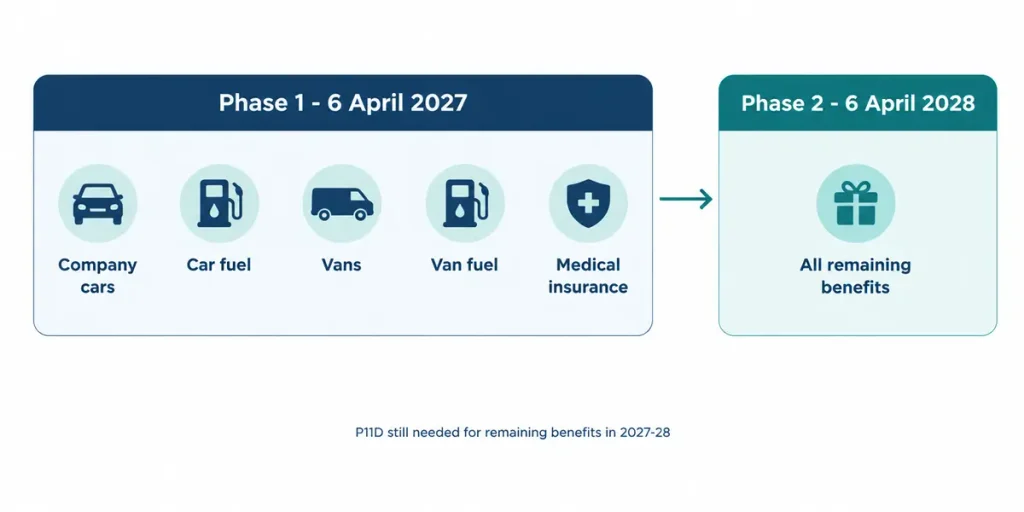
From 6 April 2027, the way UK employers report some benefits in kind will change significantly. Company cars, car fuel, vans, van fuel and employer-provided medical benefits will have to be reported through payroll in real time rather than through the usual year-end P11D process.
Most other benefits will follow from April 2028. However, employment-related loans and accommodation are currently excluded from mandatory payrolling and will remain voluntary until the government confirms otherwise.
For businesses providing taxable benefits to employees, preparation should start well before April 2027.
Key takeaways
- Mandatory payrolling starts on 6 April 2027 for company cars, car fuel, vans, van fuel and employer-provided medical benefits.
- Most other benefits in kind become mandatory from April 2028.
- Employment-related loans and accommodation remain outside mandatory payrolling for now.
- Both Income Tax and employer Class 1A National Insurance contributions will be reported in real time for mandatorily payrolled benefits.
- P11Ds will still be required for benefits that remain outside mandatory payrolling.
- Employers do not need to register for the benefits that become mandatory in April 2027.
- HMRC plans to remove affected benefits from employees’ tax codes before mandatory payrolling begins.
What is payrolling of benefits in kind?
Payrolling benefits in kind means including the taxable value of an employee’s benefit in each payroll run instead of relying on year-end reporting.
For example, if an employee receives a medical benefit worth £600 for the year, the employer would normally include £50 of taxable benefit in each monthly payroll period. That amount is added for Income Tax purposes rather than being additional cash paid to the employee.
HMRC’s current mandatory payrolling guidance confirms that employers will report affected benefits through payroll software using Real Time Information.
Employers have been able to payroll certain benefits voluntarily for several years. From April 2027, however, payrolling becomes compulsory for the first group of benefits.
What changes from 6 April 2027?
The original mandatory payrolling start date was April 2026, but the government delayed implementation to provide employers, agents and payroll software developers with more time to prepare.
From 6 April 2027, mandatory payrolling applies to:
- Company cars
- Car fuel
- Vans
- Van fuel
- Employer-provided medical benefits, including relevant private medical cover
These benefits must be reported through the employer’s Full Payment Submission. HMRC’s reporting requirements confirm that the taxable benefit and associated Income Tax and Class 1A National Insurance contributions will be reported in real time.
Employers operating company car schemes should pay particular attention to data quality. The taxable benefit can depend on factors including the car’s list price, CO₂ emissions, fuel type and availability. Our guide to company car tax bands explains how the taxable value is calculated.
What happens from April 2028?
From April 2028, mandatory payrolling is expected to extend to most remaining benefits in kind.
There is an important exception. Employment-related loans and accommodation are not currently scheduled to become mandatory in April 2028. HMRC says these benefits will remain available for voluntary payrolling, with any future mandatory date to be confirmed separately.
Employers should therefore avoid treating April 2028 as the complete abolition of the P11D system.
What happens to P11D forms?
P11Ds will not disappear in April 2027.
For the 2027/28 tax year, benefits outside phase one will generally still need to be reported under the existing year-end arrangements unless they are voluntarily payrolled.
This means a business providing company cars and private medical benefits alongside another non-mandatory benefit could payroll the cars and medical benefits throughout 2027/28 while continuing to report the other benefit after the tax year.
Even after April 2028, P11D and P11D(b) reporting can continue to be relevant for benefits such as loans and accommodation that have not been voluntarily payrolled, as well as certain excluded cases.
Class 1A National Insurance also changes. The employer remains responsible for the contribution, but for mandatorily payrolled benefits it will be calculated, reported and paid through the real-time process rather than solely through the traditional year-end P11D(b) route.
What employers should do now
1. Review and clean benefit data
Benefit records should be checked well before the first mandatory payroll run.
For company cars, make sure information such as list price, registration details, CO₂ emissions, fuel type, employee availability dates and changes during the year is accurate.
For medical benefits, employers need reliable information about the taxable cost attributable to each employee.
Incorrect data can lead directly to incorrect payroll calculations.
2. Do not register for mandatory benefits
Employers do not need to register to payroll company cars, car fuel, vans, van fuel or medical benefits from April 2027.
HMRC’s preparation guidance states that these benefits will enter mandatory payrolling automatically.
A voluntary registration service is instead due to open in November 2026 for employers wishing to payroll benefits that are not mandatory during phase one. The registration deadline for the 2027/28 tax year is 5 April 2027.
3. Check your payroll software
Employers should confirm that their software provider will support the additional benefit-in-kind information required through RTI.
HMRC expects updated technical specifications to be available to software providers in autumn 2026. Businesses using outsourced payroll services should also confirm how their provider will collect benefit information and handle changes during the tax year.
4. Brief employees before April
Employees may notice the tax on benefits more clearly through their regular payslips once payrolling becomes mandatory.
Explaining the change beforehand can reduce queries, particularly for employees receiving company cars or medical benefits.
HMRC has said it will automatically remove mandatorily payrolled benefits from affected employees’ tax codes for the start of the 2027/28 tax year, helping prevent the same benefit being taxed through both the code and payroll.
5. Prepare for changes during the year
Benefits do not always remain unchanged for 12 months.
A company car may be replaced, an employee may join or leave midway through the year, or the taxable cost of a medical benefit may change. HMRC’s real-time approach allows the annual taxable value to be recalculated and the remaining amount spread across the remaining pay periods.
Employers should establish a process for passing these changes to payroll quickly.
6. Plan for the Class 1A NIC cash-flow overlap
There is also a one-off cash-flow consideration in 2027.
Employers may still have Class 1A National Insurance to pay in July 2027 for benefits provided during 2026/27, while simultaneously starting to pay Class 1A NIC in real time on benefits provided during 2027/28.
Businesses should account for this overlap when planning payroll-related cash flow.
A worked example: payrolling a company car
Assume a director has a company car with an annual taxable benefit of £6,000.
Under mandatory payrolling, the employer would normally spread that amount across 12 monthly pay periods:
£6,000 ÷ 12 = £500 taxable benefit per month
If the employee pays Income Tax at 20%, the additional tax attributable to the benefit would be £100 per month. At a 40% Income Tax rate, it would be £200 per month.
The £500 is not additional salary paid to the director. It is included in the payroll calculation so the appropriate tax can be collected as the benefit is provided.
If the car changes during the year and the annual taxable value changes, the employer recalculates the benefit, deducts the amount already payrolled and spreads the remaining taxable amount over the remaining pay periods.

Does this change business expenses?
Ordinary business expenses that are paid or reimbursed and qualify fully for tax relief remain exempt and normally do not need to be reported as benefits in kind.
Different rules can apply where an expense is taxable or does not qualify fully for relief. Employers should therefore distinguish between genuine business expenses and taxable employee benefits rather than treating all expense payments in the same way.
Employees may also be able to claim tax relief on qualifying work-related expenses where the relevant conditions are met.
FAQ
Is the P11D being abolished?
Not completely.
P11Ds will stop being the normal reporting method for benefits brought into mandatory payrolling, but they will continue to have a role for benefits and circumstances that remain outside the mandatory regime.
Loans and accommodation, for example, are currently expected to remain voluntary even after April 2028.
Can I start payrolling before it becomes mandatory?
Existing voluntary arrangements can continue where an employer registered in time for the 2026/27 tax year.
For 2027/28, HMRC plans to reopen voluntary registration in November 2026 for benefits that are not part of the mandatory phase-one group.
There is no need to register company cars, car fuel, vans, van fuel or medical benefits for April 2027 because those categories become mandatory automatically.
What happens if I do nothing before April 2027?
Employers providing benefits covered by phase one will still be required to report them through payroll from 6 April 2027.
HMRC has announced a first-year easement for certain non-deliberate inaccuracies in mandatory RTI reporting during 2027/28. However, deliberate non-compliance is not protected, and normal late-filing, late-payment and statutory interest rules can still apply.
Businesses should therefore use the remaining preparation period to review their records, software and payroll procedures.
Will employees be taxed twice?
HMRC says it intends to remove the mandatorily payrolled benefits from affected employees’ tax codes before 6 April 2027.
Employers should nevertheless make sure benefit information is accurate and encourage employees to check their tax codes and payslips when the new system begins.
How Apex can help
Moving benefits into real-time reporting affects much more than a single payroll field. Employers need accurate benefit records, suitable software, reliable employee data and processes for handling changes throughout the year.
Apex Accountants & Tax Advisors provides payroll services for UK businesses, including PAYE calculations, RTI submissions, payroll records, workplace pension administration and ongoing payroll compliance.
We can also help businesses review their benefit data, prepare payroll processes for the April 2027 transition and coordinate benefit reporting with wider payroll obligations.
With mandatory payrolling approaching, preparing the data and process early can make the first real-time reporting year considerably easier.
Recent Posts
Payrolling Benefits in Kind: What Employers Must Do by 2027
From 6 April 2027, the way UK employers report some benefits in kind will change significantly. Company cars, car fuel,...

UK Wealth Tax: Would Business Owners and High Earners Pay?
Owning a valuable business does not necessarily mean having substantial cash available personally. Equally, earning a high salary does not...

Self Assessment Registration Deadline: What to Do Before 5 October 2026
We’re increasingly asked by clients who started trading during 2025/26: “Do I need to register for Self Assessment?” It’s a...

R&D Tax Relief 2026: New HMRC Rules and How to Claim Successfully
We’re seeing more companies come to us after having their R&D tax relief claims questioned, returned, or rejected by HMRC....

HMRC Auto-Registration for MTD: What Happens If You Don’t Sign Up First
Sole traders and landlords are increasingly asking what happens if they do not respond to Making Tax Digital sign-up letters....

A Complete Guide to UK Airbnb Tax: Rules, Reliefs and Rates for 2026/27
A host can receive regular Airbnb bookings and still be unsure whether HMRC sees the income as a small side...

Inheritance Tax Planning: A Practical UK Guide for 2026
A couple in their late sixties own a home worth £750,000 and have £700,000 in savings and investments. Their combined...

Accountant for Community Pharmacy UK: VAT and Tax Guide
A pharmacy can look profitable on paper while still facing tight cash flow. NHS income, retail sales, dispensing margins, staff...

HMRC’s First Cryptoasset Statistics Show Why Records Matter
Capital Gains Tax is becoming increasingly important for UK crypto investors as HMRC gains access to more detailed information about...

Making Tax Digital for Income Tax 2026: What to Do Now
A sole trader may have completed the first MTD quarterly update without realising that the next deadline is already approaching....