
-
CALL US 0203 883 4777
HMRC Auto-Registration for MTD: What Happens If You Don’t Sign Up First

Sole traders and landlords are increasingly asking what happens if they do not respond to Making Tax Digital sign-up letters. From September 2026, HMRC is beginning a new phase of the rollout by signing up people who need to use MTD for Income Tax for 2026/27 but have not already done so themselves.
This change forms part of the wider MTD for Income Tax requirements for 2026, which include digital record-keeping, quarterly updates and an annual tax return through compatible software.
The main concern is not simply that HMRC may sign you up first. Automatic sign-up relies on information HMRC already holds, so recent changes to your self-employment or property income may not be reflected. Signing up yourself gives you more opportunity to check that your details are correct before quarterly reporting begins.
HMRC reported in August 2026 that more than 570,000 customers had signed up and more than 436,000 had already submitted their first quarterly update.
Key Takeaways
- From September 2026, HMRC is beginning to sign up people who need MTD for Income Tax for 2026/27 but have not signed up themselves.
- The £50,000 threshold is based on qualifying income shown on your 2024/25 Self Assessment return. Qualifying income means gross self-employment and property income before expenses, not profit.
- 11 September 2026 is not a legal sign-up deadline. However, the MTD sign-up service will be unavailable from 5pm on 11 September until 1pm on 15 September for planned maintenance.
- No penalty points will be issued for late quarterly updates during 2026/27, although the updates are still required.
- If your circumstances have changed since your last tax return, checking your details before HMRC completes the sign-up can prevent additional work later.
What is MTD for Income Tax auto-registration?
MTD for Income Tax auto-registration refers to HMRC signing up taxpayers who are required to use Making Tax Digital but have not completed the process themselves.
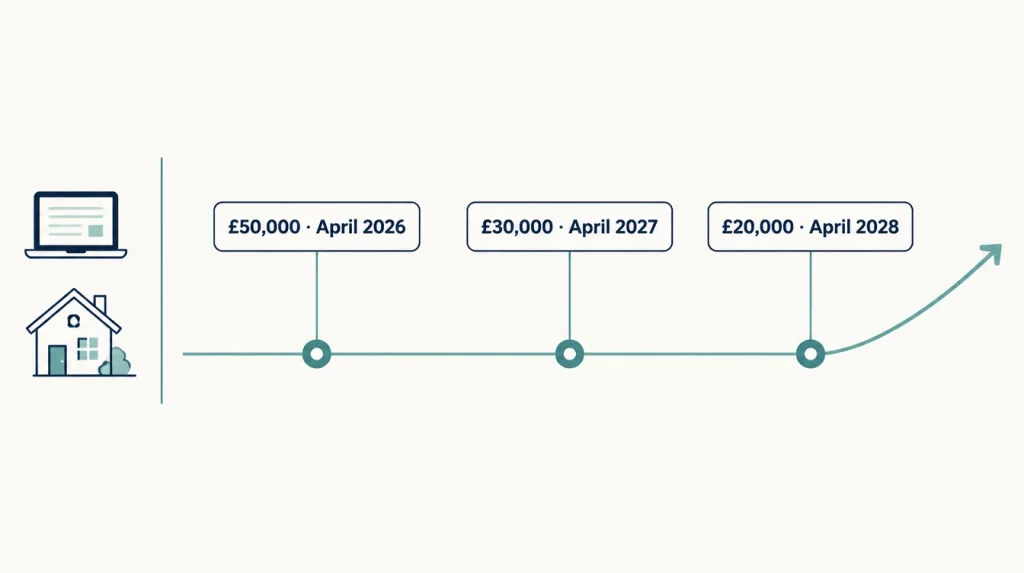
Making Tax Digital for Income Tax became mandatory from 6 April 2026 for qualifying sole traders and landlords with more than £50,000 of qualifying income.
The underlying obligation has therefore not changed. What has changed is HMRC’s approach to people who remain outside the system despite meeting the criteria.
According to HMRC’s August 2026 MTD update, automatic sign-up will take place in stages over the coming months.

Who gets auto-registered for MTD?
For the 2026/27 tax year, MTD applies to sole traders and landlords whose qualifying income for 2024/25 was more than £50,000.
HMRC’s qualifying income rules confirm that this is based on gross income before expenses rather than taxable profit.
| Tax return used | Qualifying income | MTD starts |
|---|---|---|
| 2024/25 | More than £50,000 | 6 April 2026 |
| 2025/26 | More than £30,000 | 6 April 2027 |
| 2026/27 | More than £20,000 | 6 April 2028 |
For sole traders, this means Making Tax Digital affects more than the way tax is ultimately calculated. It changes how business records are maintained, how income and expenses are reported and how frequently information is submitted to HMRC.
What counts as qualifying income?
Qualifying income generally includes:
- Gross self-employment income before expenses
- Gross property income before expenses
- Income from multiple self-employment or property sources added together
- Certain income from a source that has since ceased, where another qualifying source continues
What does not normally count?
The following income is not included when calculating the MTD qualifying-income threshold:
- Employment income through PAYE
- Dividends
- State Pension or private pension income
- An individual’s share of partnership profit
For example, if you received £27,000 from self-employment and £25,000 in gross rental income during 2024/25, your qualifying income would be £52,000.
You would therefore fall above the £50,000 threshold even if your expenses reduced your taxable profit considerably.
What are the risks of waiting for HMRC to sign you up?
Automatic sign-up does not remove your responsibility to ensure the information held by HMRC is correct.
The biggest issue is that HMRC may be working from your previous Self Assessment return rather than your current circumstances.
Ceased income sources
If you stopped a self-employment activity or ceased receiving income from a property after submitting your previous return, HMRC’s records may still show the old source.
Closing one source does not necessarily mean you are outside MTD if another qualifying source continues.
New income sources
You may also have started a new business or begun receiving rental income since your previous tax return.
If HMRC does not yet hold that information, you may need to add the new source yourself.
All qualifying income has ceased
If you have stopped all self-employment and property activities, contact HMRC rather than assuming an automatic MTD registration can simply be ignored.
HMRC may need to update its records and confirm whether you are still required to use the service.
Software still needs to be arranged
Being signed up by HMRC does not automatically configure accounting software for you.
You still need compatible software, appropriate digital records and a process for submitting quarterly updates.
How do you sign up for MTD for Income Tax yourself?
HMRC’s MTD sign-up guidance explains the information needed to complete the process.
You generally need to be registered for Self Assessment and to have submitted a tax return within the previous two years.
If you sign up yourself, you use the Government Gateway account associated with your Self Assessment record.
Before completing the process, check that you can:
- Confirm the tax year from which MTD applies to you
- Review your self-employment and property income sources
- Add any sources that are missing
- Provide the relevant business or property start dates
- Confirm your business details where required
- Choose suitable MTD-compatible software
If an accountant or tax agent handles the process, they use their own Agent Services Account and the relevant HMRC authorisation rather than your personal Government Gateway password.
What is the MTD service downtime in September 2026?
HMRC has scheduled maintenance for the MTD for Income Tax service from 5pm on Friday 11 September until 1pm on Tuesday 15 September 2026.
This means the service will temporarily be unavailable, but 11 September is not a statutory MTD registration deadline.
HMRC’s current MTD service availability information also lists another maintenance period from 7pm on Saturday 26 September until 9am on Monday 28 September 2026.
If you want to complete your registration before the first maintenance window, you should therefore do so before 5pm on 11 September.
If you have not registered by then, the service is scheduled to reopen on 15 September. The important question is whether HMRC has already completed the automatic sign-up by that point.
What happens if you are late with quarterly updates?
HMRC will not issue penalty points for late quarterly updates during the first mandatory MTD tax year, 2026/27.
That does not mean quarterly updates are optional. Outstanding submissions still need to be dealt with, and separate penalties can apply to late annual tax returns and late tax payments.
From 2027/28, HMRC’s MTD penalty system begins applying to quarterly updates.
| Position | Penalty |
|---|---|
| Each missed quarterly deadline | 1 penalty point |
| 4 points accumulated | £200 penalty |
| Further missed deadline while at threshold | Additional £200 penalty |
If you remain below the four-point threshold, a penalty point normally expires 24 months after the missed deadline.
Once the threshold is reached, however, the points do not simply disappear after two years. You generally need to complete a period of compliance and bring outstanding submissions up to date before the points are reset.
If you missed the first quarterly update in August 2026, dealing with it early is preferable to allowing reporting problems to accumulate. This may involve correcting your MTD records and checking that your bookkeeping is ready for the next submission.
Are there exemptions from MTD for Income Tax?
Yes. Some taxpayers may be exempt from Making Tax Digital.
One important category is digital exclusion. This can apply where it is not reasonably practical for someone to use digital tools because of factors such as:
- Age
- Disability
- Health conditions
- Religious beliefs
- Lack of suitable internet access
- Other circumstances making digital reporting unreasonable
HMRC’s MTD exemption guidance explains who may qualify and how applications are considered.
Being exempt from MTD does not mean the underlying income no longer needs to be reported. You must still meet your normal Self Assessment obligations.
If you are already using MTD and your qualifying income later falls below the threshold, one lower-income year will not usually remove you from the system immediately.
HMRC generally requires qualifying income to remain below the relevant threshold for three consecutive tax years before you can choose to leave MTD, subject to the circumstances applying to you.
How should sole traders and landlords prepare for the next thresholds?
MTD will expand further over the next two years.
From 6 April 2027, individuals with qualifying income above £30,000 will be brought into the system based on their 2025/26 tax return.
From 6 April 2028, the threshold will fall again to more than £20,000 based on qualifying income for 2026/27.
If your income falls into these ranges, preparation should start before the mandatory date.
Practical steps include:
- Checking your gross self-employment and property income
- Making sure all relevant income sources appear correctly on your Self Assessment return
- Choosing compatible software in advance
- Keeping business and property records digitally
- Reconciling records regularly rather than waiting until a quarterly deadline
- Confirming your MTD start date with your accountant
Consistent digital bookkeeping can make this easier by keeping income, expenses and supporting records organised throughout the year.
This becomes especially important because errors made during routine record-keeping can carry through into quarterly updates and ultimately affect the annual tax return.
Voluntary MTD sign-up is also available before your mandatory start date, but it should not be treated simply as a consequence-free trial. Once you enter the system, you need to understand the digital record-keeping and reporting obligations that apply.
Frequently Asked Questions
What if HMRC auto-registers me with the wrong details?
Check your MTD account as soon as you receive confirmation that HMRC has signed you up.
Automatic registration relies on information HMRC already holds, so changes made since your most recent tax return may not appear immediately.
Some details can be updated through the service, while more significant changes may require you to contact HMRC.
Do I still need to file a Self Assessment tax return under MTD?
Yes.
Quarterly updates do not replace your annual tax return. MTD users still complete an annual Self Assessment tax return through compatible software.
Other income, gains, allowances and reliefs that are not included in the quarterly updates are dealt with before the final return is submitted.
Can my accountant sign me up for MTD?
Yes.
An authorised accountant or tax agent can complete the registration process on your behalf using HMRC’s agent services.
They can also check that your income sources are correctly listed, connect suitable software and manage ongoing quarterly reporting.
How much does MTD-compatible software cost?
Costs vary depending on the provider and the features you need.
Some platforms are designed for straightforward sole-trader bookkeeping, while others include invoicing, bank feeds, receipt capture, property management and more advanced accounting features.
The important point is that the software must be compatible with MTD for Income Tax and suitable for the records you need to maintain.
What happens if I miss the 11 September sign-up date?
Nothing automatically happens simply because 11 September passes.
It is not a legal MTD sign-up deadline.
The significance of the date is that HMRC’s sign-up service is scheduled to become unavailable from 5pm on 11 September until 1pm on 15 September.
When the service reopens, you can still sign up if HMRC has not already completed the process on your behalf.
Will MTD for Income Tax apply to limited companies?
No.
MTD for Income Tax applies to individuals with qualifying self-employment or property income, including sole traders and landlords.
Limited companies have separate Corporation Tax and VAT obligations.
However, a company director may still fall within MTD personally if they also receive sufficient qualifying self-employment or property income.
How Apex Accountants Can Help
If you are unsure whether HMRC has already signed you up, whether your income sources are correct or whether your records are ready for quarterly reporting, our Making Tax Digital accountants can help with registration, software setup and ongoing submissions.
MTD should also be considered alongside your wider personal tax position, particularly where you receive income from several sources or have additional Self Assessment obligations.
If you want to confirm where you stand before HMRC completes an automatic sign-up or before the next quarterly deadline, you can book a consultation to review your qualifying income, current registration position and MTD setup.
Recent Posts
HMRC Auto-Registration for MTD: What Happens If You Don’t Sign Up First
Sole traders and landlords are increasingly asking what happens if they do not respond to Making Tax Digital sign-up letters....

A Complete Guide to UK Airbnb Tax: Rules, Reliefs and Rates for 2026/27
A host can receive regular Airbnb bookings and still be unsure whether HMRC sees the income as a small side...
Inheritance Tax Planning: A Practical UK Guide for 2026
A couple in their late sixties own a home worth £750,000 and have £700,000 in savings and investments. Their combined...

Accountant for Community Pharmacy UK: VAT and Tax Guide
A pharmacy can look profitable on paper while still facing tight cash flow. NHS income, retail sales, dispensing margins, staff...

HMRC’s First Cryptoasset Statistics Show Why Records Matter
Capital Gains Tax is becoming increasingly important for UK crypto investors as HMRC gains access to more detailed information about...

Making Tax Digital for Income Tax 2026: What to Do Now
A sole trader may have completed the first MTD quarterly update without realising that the next deadline is already approaching....

MTD for Income Tax: What Sole Traders and Landlords Should Do After the First Deadline
A client came to Apex Accountants last week, a sole trader with two income streams, unsure whether she had met...

HMRC’s 436,000 MTD Milestone: What Sole Traders and Landlords Should Do Before September
We are increasingly asked the same question by clients who have heard about Making Tax Digital but are not sure...

HMRC Late Payment Interest Rate: What 7.75% Costs You
Miss a tax deadline today and HMRC charges 7.75% a year on the outstanding balance. The Bank of England’s base...

Electricity VAT Cut 2026: What the Six-Month Zero Rate Means from 1 October
The government’s announcement, made in July by new Prime Minister Andy Burnham as one of his first acts in office,...