
-
CALL US 0203 883 4777
Autumn Budget 2026 Date Confirmed for 28 October

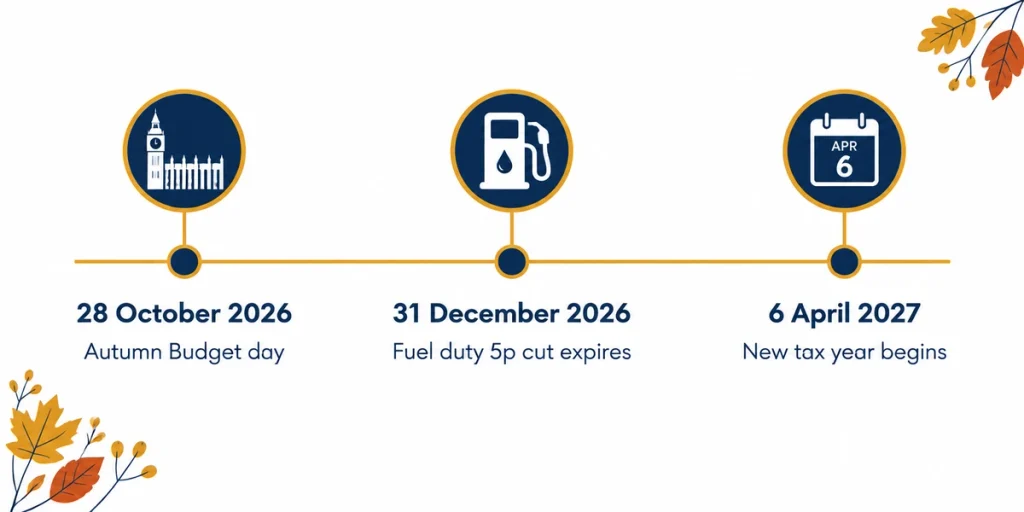
The Chancellor, John Healey, will deliver the Autumn Budget 2026 on Wednesday, 28 October, HM Treasury has confirmed. The confirmed budget date ends months of speculation about timing, and for directors and owners of UK limited companies, it is the single most important fiscal event of the year: one statement sets the tax arithmetic for the year ahead, at a moment when public finances are unusually tight and speculation about what the budget might change is running well ahead of the facts.
Key takeaways
- The Budget 2026 takes place on Wednesday, 28 October, with fresh forecasts from the Office for Budget Responsibility on the same day.
- Only the date is confirmed so far; the government has declined to preview any tax measures.
- Four areas matter most to limited companies: fuel duty, threshold freezes, corporation tax and making tax digital.
- A little preparation in October beats a January surprise.
What has been confirmed
The date itself. Updated forecasts from the Office for Budget Responsibility will accompany the Budget, and most commentators expect them to look gloomier than the set issued alongside the Spring Statement in March.
Headroom against the government’s fiscal rules was already wafer-thin earlier in the year, and the Institute for Government notes that whatever the Chancellor announces must set the course for the rest of the parliament, reassure the markets and fund the government’s priorities all at once.
For company directors, the confirmed Autumn Budget 2026 date gives businesses a clear deadline to review cash flow, investment plans and tax exposure before any new measures are announced.
The government has put growth at the centre of its agenda, with more investment, more innovation and more jobs, and it has signalled that it intends to build on existing fiscal discipline rather than shake the financial markets. Beyond that, ministers have declined to preview any measures on the basis that responding to speculation only creates more of it. The budget itself will lay out the plans.
Measures already announced before the budget
The government has already introduced a handful of smaller measures designed, in its words, to give people and businesses “a little breathing space”:
- VAT has come off household electricity bills from 1 October 2026 until at least March 2027, a saving of around £3.75 a month for the average household.
- Business rates relief now applies to pubs, social clubs and live music venues.
- The £2 cap on single bus fares is back in place for the whole of 2027.
None of these directly change the tax position of a typical limited company, but they set the tone: the government wants visible cost relief where it can find the money, funded by reprioritising existing budgets rather than new borrowing.
What the Autumn Budget 2026 could change for business owners
Several autumn budget 2026 predictions could affect companies and their directors, making it sensible to review current tax, investment and remuneration plans before 28 October.
Fuel Duty
Fuel duty will be an important area to watch at the autumn budget 2026. The current 5p-per-litre reduction is due to remain in place until 31 December 2026, after which the government will need to set the rates that apply from January 2027.
For businesses that depend heavily on vehicles, including those operating vans, delivery fleets, company cars or field-based teams, any change to fuel duty could have a direct impact on running costs. Companies may therefore want to factor possible changes into their transport budgets and cash-flow forecasts before making decisions for 2027.
Tax thresholds and allowances
Tax thresholds and allowances are the other quiet lever. Successive freezes to income tax and National Insurance thresholds have pulled more income into higher bands over time, and any extension of those freezes, or a fresh freeze on the personal allowance, would hit owner-managers who pay themselves through a combination of salary and dividends.Directors can check the current UK tax rules and allowances before reviewing how changes may affect their remuneration strategy.
While our expert self-assessment specialists can handle the filing side for directors, helping review salary and dividend income, check available allowances and ensure the return reflects the director’s wider personal tax position accurately.
Corporation Tax planning support
The corporation tax main rate is another area businesses should keep under review, particularly for companies above £250,000, where the 25% main rate applies.
For 2026/27, profits over £250,000 are taxed at 25%, while profits of £50,000 or less pay 19%, with marginal relief applying in between. The government has confirmed it will maintain these rates and thresholds for the financial year beginning 1 April 2027, subject to any future budget changes.
Our corporation tax planning helps directors understand how the current rate affects taxable profits and profit extraction. We also support companies with corporation tax calculations, return preparation, relief reviews and year-end planning to keep their tax position accurate and well managed.
Wider tax reform
Wider tax reform is another area businesses should watch closely. The Budget could provide an opportunity for changes affecting property and business taxation, although no specific measures have been confirmed. Company owners should therefore focus on announced policy rather than speculation and be ready to review their tax planning once the final measures are published.
Making tax digital
Finally, digital tax reporting keeps rolling forward, regardless of the budget day headlines. Making Tax Digital for Income Tax continues its phased rollout, and company directors who also have self-employment or property income should already check whether their bookkeeping will meet the quarterly reporting requirements. For those within scope, MTD requires compatible software to keep digital records and submit quarterly updates to HMRC.
Our cloud accounting team can set up MTD-ready bookkeeping systems, connect compatible software and help ensure records are organised correctly before quarterly reporting begins.
Four practical steps to take before 28 October
- Review your profit extraction strategy for the current tax year, including salary, dividends and pension contributions, so you can adjust quickly if thresholds or rates change.
- Time to make major purchases sensibly. If you weigh up equipment, vehicles or IT investment, know whether any change to capital allowances could make acting before or after the Budget more efficient. A budgets and forecasting session maps the options on your numbers.
- Check your VAT position, particularly if you trade with the EU or sell digital services, as indirect tax tweaks are a common Budget feature. Our VAT team reviews your exposure before deadlines move.
- Book a review with your accountant in November. Budgets change the arithmetic of everything from dividend timing to payroll, and a post-Budget check of your numbers for the new tax year costs far less than a surprise in January.
How Apex can help
Apex Accountants will publish a full response to the Autumn Budget 2026 on the day, with a simple breakdown of every change that affects limited companies and their directors. Before then, our corporation tax and self-assessment specialists can review your current extraction strategy so you know exactly which budget decisions would affect you. If you would like a personal review of how the budget affects your business, book a consultation today!

The bottom line
The 28 October budget will shape tax policy for the rest of this parliament. For limited company owners, the best approach is to stay calm: understand the confirmed facts, separate reliable information from Autumn Budget 2026 predictions, and have a plan ready for the changes that would actually affect your numbers.
Recent Posts
Autumn Budget 2026 Date Confirmed for 28 October
The Chancellor, John Healey, will deliver the Autumn Budget 2026 on Wednesday, 28 October, HM Treasury has confirmed. The confirmed...

Director Tax Return 2025/26: New Self Assessment Rules for Close Company Directors
If you run an owner-managed or family company, your director tax return 2025/26 asks for more information than ever before....

Business Rates Relief 2026: Could the Threshold Increase?
The current relief thresholds have not changed. Business rates relief 2026 has not adopted a £17,096 exemption threshold. A newspaper...

Taking Money Out of Your Company: 2026 Rule Changes Explained
On 14 September 2026, HMRC closed its consultation on modernising the taxation of distributions and repayments of capital from companies....

Is the UK Tax System Too Complex for Small Businesses in 2026?
For many small businesses, keeping up with tax now means managing several filing cycles, digital reporting requirements and separate payment...

How the UK Exit Tax Proposal Could Introduce a 20% Charge for Individuals and Businesses
The proposed UK exit tax is a one-off charge, reported at around 20%, on unrealised gains in UK business and...

Payrolling Benefits in Kind: What Employers Must Do by 2027
From 6 April 2027, the way UK employers report some benefits in kind will change significantly. Company cars, car fuel,...

UK Wealth Tax: Would Business Owners and High Earners Pay?
Owning a valuable business does not necessarily mean having substantial cash available personally. Equally, earning a high salary does not...

Self Assessment Registration Deadline: What to Do Before 5 October 2026
We’re increasingly asked by clients who started trading during 2025/26: “Do I need to register for Self Assessment?” It’s a...

R&D Tax Relief 2026: New HMRC Rules and How to Claim Successfully
We’re seeing more companies come to us after having their R&D tax relief claims questioned, returned, or rejected by HMRC....