
-
CALL US 0203 883 4777
What Happens If You Miss the Self Assessment Deadline in 2027?
If you need to file a tax return for the 2025/26 tax year, the self-assessment deadline is 31 January 2027. Miss it by a single day, and a £100 late-filing penalty can apply, even if you owe no tax. On 8 October 2026, HMRC published research showing that more than 26% of people surveyed experience anxiety when tax or financial deadlines approach, and it is encouraging Self Assessment customers to start early rather than leave their return until the final days of January.
This guide sets out every deadline for the 2025/26 return, the full penalty ladder for late filing and late payment, and what to do if the date has already passed.
Key takeaways
- Online returns for 2025/26 are due by 31 January 2027; paper returns by 31 October 2026.
- A £100 late-filing penalty applies from one day late, even where there is no tax to pay.
- After three months, daily penalties of £10 can apply for up to 90 days, reaching a maximum of £900; further penalties can arise at six and 12 months.
- Paying late can trigger 5% penalties at 30 days, six months and 12 months, plus late-payment interest. The HMRC late-payment interest rate is currently 7.75% as of October 2026, but it can change.
- You can usually appeal a penalty within 30 days of the date it was issued if you have a reasonable excuse. If you cannot pay your bill in full, you may also be able to arrange a Time to Pay payment plan with HMRC.
What Is the Self Assessment Deadline for the 2025/26 Tax Year?
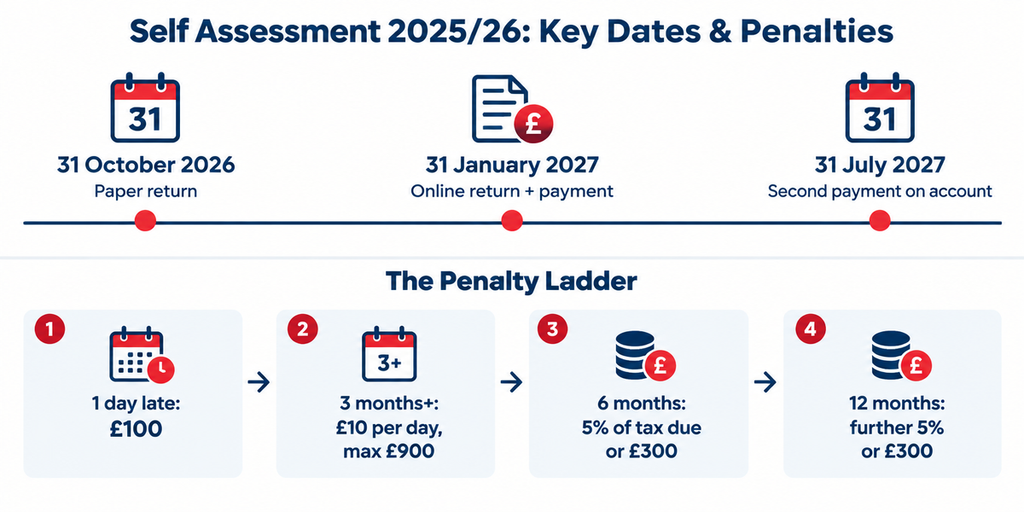
The 2025/26 tax year ran from 6 April 2025 to 5 April 2026.The self-assessment deadline 2026 applies to paper returns, which must be filed by 31 October 2026, while online returns are due by 31 January 2027. Understanding the deadlines for self assessment tax returns is important because filing and payment dates do not always fall at the same time. Three dates matter, and the first has already passed by the time HMRC starts its annual push:
| Date | What Is Due |
| 31 October 2026 | Paper Self Assessment tax return for 2025/26 |
| 31 January 2027 | Online Self Assessment tax return, any balancing payment for 2025/26, and the first payment onself-assessment account for 2026/27 |
| 31 July 2027 | Second payment on account for 2026/27 |
Payments on account are advance instalments towards your next tax bill, each normally half of your previous year’s liability. If your income has fallen, you can ask HMRC to reduce it, but you should keep evidence in case HMRC checks the claim.
For a complete breakdown of the filing and payment dates, read the official HMRC guidance on self-assessment submission deadlines. It explains when to submit your tax return online or by post, when to pay your tax bill, and the deadlines for payments on account.
If you registered late, watch the 5 October rule too. HMRC can charge a separate ‘failure to notify’ penalty if you register for Self Assessment after 5 October and have not paid your full bill by the January tax return deadline.
Read our guide to the self-assessment registration deadline to understand the key dates and registration requirements.
What Happens If You File Your Tax Return Late?
HMRC issues late filing penalties in stages, and each stage stacks on top of the last. You can read the official HMRC guidance on Self Assessment penalties for more details about late filing, late payment and how to appeal.
| How Late | Penalty |
| 1 day | £100 fixed penalty |
| More than 3 months | £10 per day for up to 90 days, with a maximum additional penalty of £900 |
| 6 months | 5% of the tax due or £300, whichever is greater |
| 12 months | A further 5% of the tax due or £300, whichever is greater |
A worked example shows how fast this escalates. Take a sole trader who owes £4,000 for 2025/26 but files on 30 June 2027, five months late, and pays at the same moment:
- £100 fixed penalty for missing the deadline
- £610 in daily penalties (61 days after the three-month point at £10 per day)
- £200 late payment penalty (5% of the unpaid £4,000 after 30 days)
- Roughly £127 in interest at 7.75% on the unpaid tax
That comes to about £1,037 of extra cost on a £4,000 bill, more than a quarter again, before the six-month and twelve-month charges even begin. File late but pay on time, and you still face the filing penalties; pay late but file on time, and the payment penalties still apply. The two penalty regimes run separately.
Do You Pay the £100 Penalty If You Owe No Tax?
Yes. If you were required to file a self-assessment return and miss the deadline, the initial £100 late-filing penalty can apply even if you owe no tax or have paid your tax on time. If the return remains outstanding, further late-filing penalties may apply: daily penalties after 3 months, then at 6 and 12 months a penalty of 5% of the tax due or £300, whichever is greater.
What Happens If You Pay Your Tax Bill Late?
Late payment brings its own penalties, charged on the amount still unpaid. Self-assessment late payment penalties increase according to how long the outstanding tax remains unpaid.
| Stage | Penalty |
| 30 days late | 5% of the tax unpaid |
| 6 months late | A further 5% of the tax unpaid |
| 12 months late | A further 5% of the tax unpaid |
HMRC also charges interest on late payments from the due date until the date you settle the bill. Acting early can help reduce the impact of self-assessment late payment penalties and the interest that continues to accrue while tax remains outstanding. The late payment interest rate currently stands at 7.75%, a rate HMRC last changed on 9 January 2026, and HMRC reviews it when the Bank of England base rate moves. Interest compounds daily, so the balance grows quietly while the return sits unfiled.
If you cannot pay in full, act before 31 January. You can set up an online payment plan (Time to Pay) for self-assessment debts up to £30,000, provided you have no other HMRC debts or payment plans, and spread the cost in monthly instalments. For larger debts, phone HMRC’s Self Assessment payment helpline before the deadline, because agreeing to a plan early reduces the risk of penalties.
Can You Appeal a Late Filing Penalty?
Yes, if you have a reasonable excuse. Filing self-assessment tax returns early also gives taxpayers more time to check figures, plan payments and correct errors before the January deadline. HMRC accepts reasons such as serious illness, the death of a close relative, an unexpected stay in hospital, a fire or flood that destroys records, HMRC’s own online service failing on deadline day, or postal delays. It does not accept simply being too busy, forgetting, or not realising the deadline applied to you.
You normally have 30 days from the date on the penalty notice to appeal, and you can appeal online through your Government Gateway account or by post. HMRC can also cancel penalties automatically where its records show a genuine reason. If you disagree with the outcome, you can ask for a review or take the case to a tax tribunal within 30 days of HMRC’s decision.
Can You File Your 2025/26 Return Early?
Yes, and that is exactly what HMRC’s 8 October 2026 announcement encourages. If you plan to submit tax return 2027 information online, filing early gives you more time to review your figures, understand the amount due and deal with any errors before the January deadline.
You can file as soon as you have the information: forms P60 and P11D from employment, records of self-employed income and expenses, dividend and interest certificates, and pension contribution statements.
Filing in autumn spreads the workload, gives you the exact bill months before payment is due, and leaves time to arrange a payment plan or correct errors before the January tax return deadline. Starting early also protects you from the January rush, when HMRC’s phone lines and online services creak under peak demand.

FAQs About the Self-Assessment Deadline 2026
Is there a grace period after 31 January 2027?
No. The £100 penalty applies from one day after the deadline, with no automatic grace period. Some accountants report success appealing within a few days in genuine hardship cases, but the safe assumption is that the penalty stands.
Will I get a penalty if my tax return shows nothing due?
Yes. The £100 fixed penalty applies to every late return, whatever the tax outcome. HMRC charges it for lateness, not for the amount owed.
What counts as a reasonable excuse for a late return?
Serious illness or bereavement, HMRC system failures, lost records through fire or flood, and postal delays. Work pressure and forgetfulness do not qualify. You must also file as soon as the excuse ends.
What if I cannot pay the bill by 31 January?
Set up a payment plan before the deadline. Debts up to £30,000 qualify for an online Time to Pay arrangement; larger bills need a call to HMRC. Interest still runs, but timely payment penalties become avoidable.
How long do I have to appeal a penalty?
Normally 30 days from the date on the penalty notice. Keep the notice, because late appeals are harder to win.
When Do I Need to Register for Self-Assessment?
You normally need to register for self-assessment by 5 October following the end of the tax year if you have not previously filed and are required to submit a return. Check your circumstances early to avoid registration and payment issues later
How Apex Can Help You File Self Assessment Tax Return 2026
Our team files hundreds of self-assessment returns each year, and we deal with HMRC penalty cases every month, so we know where the system bites and where it gives. We can:
- Prepare and file your 2025/26 return well before the deadline, including payments on account and dividend income
- Check whether your personal tax services position can legitimately reduce the bill, from allowances to reliefs
- Draft a penalty appeal around your reasonable excuse and manage HMRC correspondence end to end
- Set up a payment plan, or review a proposed Time to Pay arrangement before you commit
- Review a lost personal allowance if your income sits near £100,000, where the tax rate effectively doubles
Book a free consultation, and we will start by confirming what you owe HMRC and by when, so nothing takes you by surprise in January. Our wider tax services cover planning for the year ahead, not just the return in front of you.
Recent Posts
What Happens If You Miss the Self Assessment Deadline in 2027?
If you need to file a tax return for the 2025/26 tax year, the self-assessment deadline is 31 January 2027....

Can You Hold Crypto ETNs in an IFISA? What Stratiphy Means for UK Investors
The position is now much clearer. Retail access to certain crypto exchange-traded notes (crypto ETNs) in an IFISA was reopened...

7 Must-Have Features in Accounting Software for Car Rental Businesses
Running a car rental company in the UK involves far more than simply handing over keys to customers. From navigating...

All You Need to Know About Companies House Late Account Filing Penalties for Private, Public Companies and LLPs
Companies House late filing penalties remain a significant concern for private companies, public companies, and LLPs across the UK. Missing...

5 VAT Strategies For Car Garages To Use In 2026
Car garages face unique challenges when it comes to managing VAT efficiently, especially as the automotive sector continues to evolve....

6 Top VAT Compliance Case Studies and Key Lessons
Understanding VAT compliance can indeed be a tough challenge. Moreover, this is especially true with the varied challenges in different...
How the 182 Day Rule Wales Affects Welsh Farm Businesses
Holiday accommodation is vital to the Welsh rural economy. Yet the 2023 tax reforms introduced a steep 182‑day letting threshold...

Optimise Your Tax Position with VAT Planning Strategies for Different Schemes
Effective VAT Planning Strategies help businesses optimise their tax position, boost cash flow, and simplify VAT compliance. Below are some...
A Practical Guide to VAT for Advertising Design Companies in the UK
Understanding VAT for advertising design companies is essential for ensuring tax compliance and maximising your business’s financial efficiency. As a...

How Bookkeeping Helps Plumbers to Stay on Track
Plumbers spend their working days repairing leaks, clearing blocked drains and installing plumbing systems, leaving limited time for financial administration....